UPSC Written Notes (Prelims & Mains GS Papers 1–4): Concise Topic-Wise Revision Compendium
High-density analytical written notes covering Indian Polity & Landmark SC Judgments, Modern History (1857–1947), Economy, Monsoon & Biodiversity Conventions, and GS-4 Ethics Case Study Strategy.
Get the complete formatted PDF right in your inbox & instant browser download.
Inside Document Preview (Pages 1–3 of 11)
Actual print-ready pages from the verified 2026–27 PDF compilation.
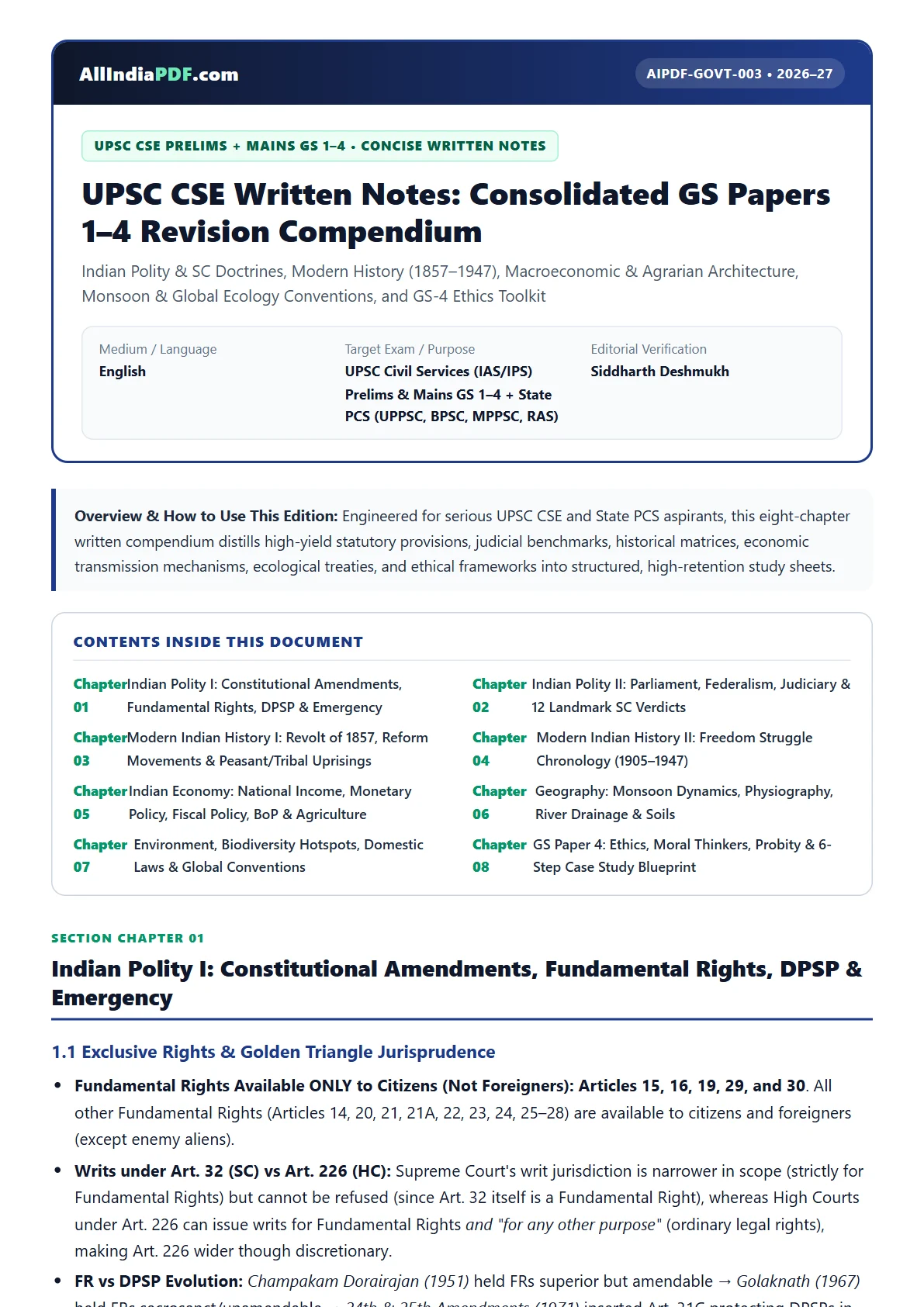
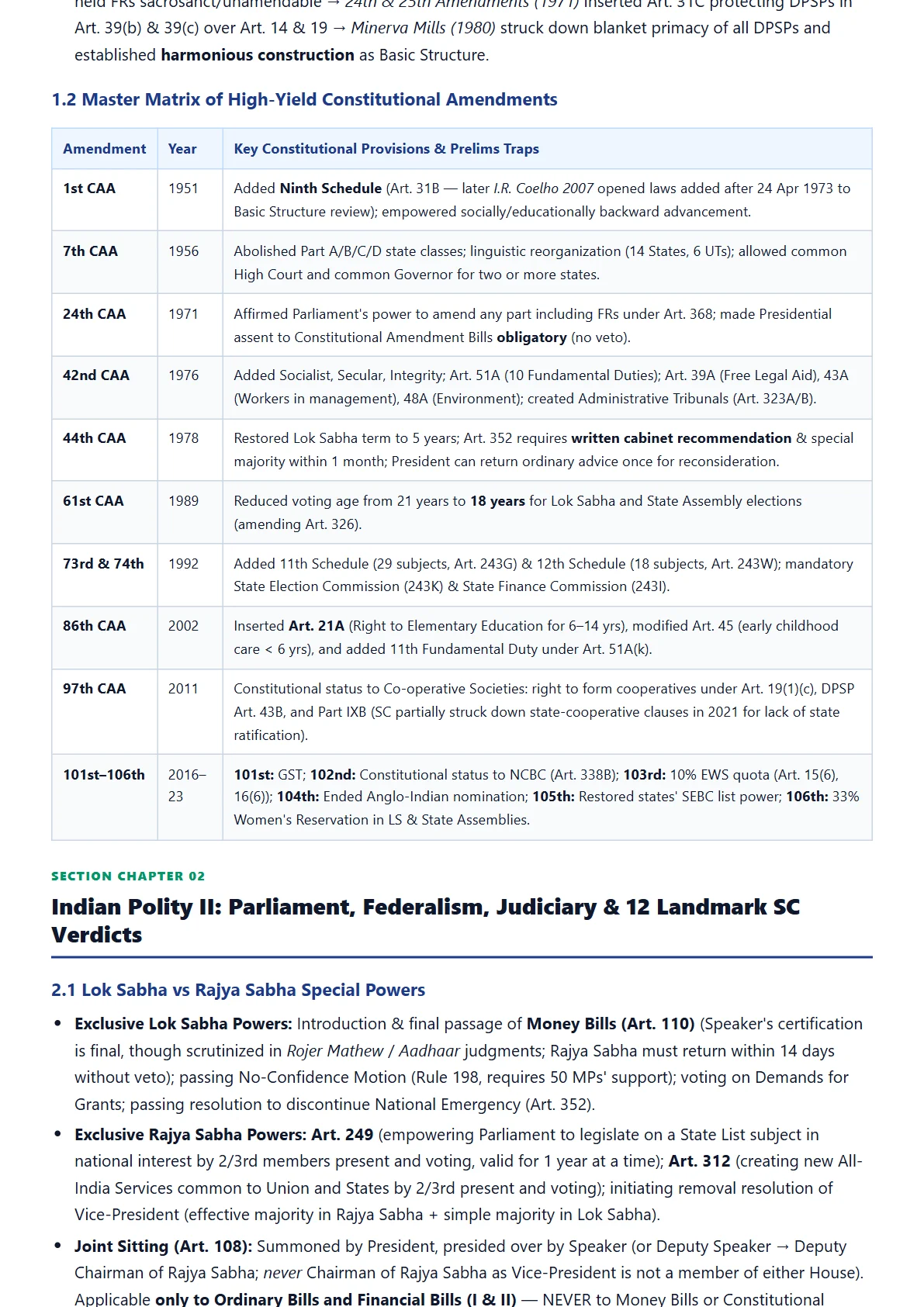
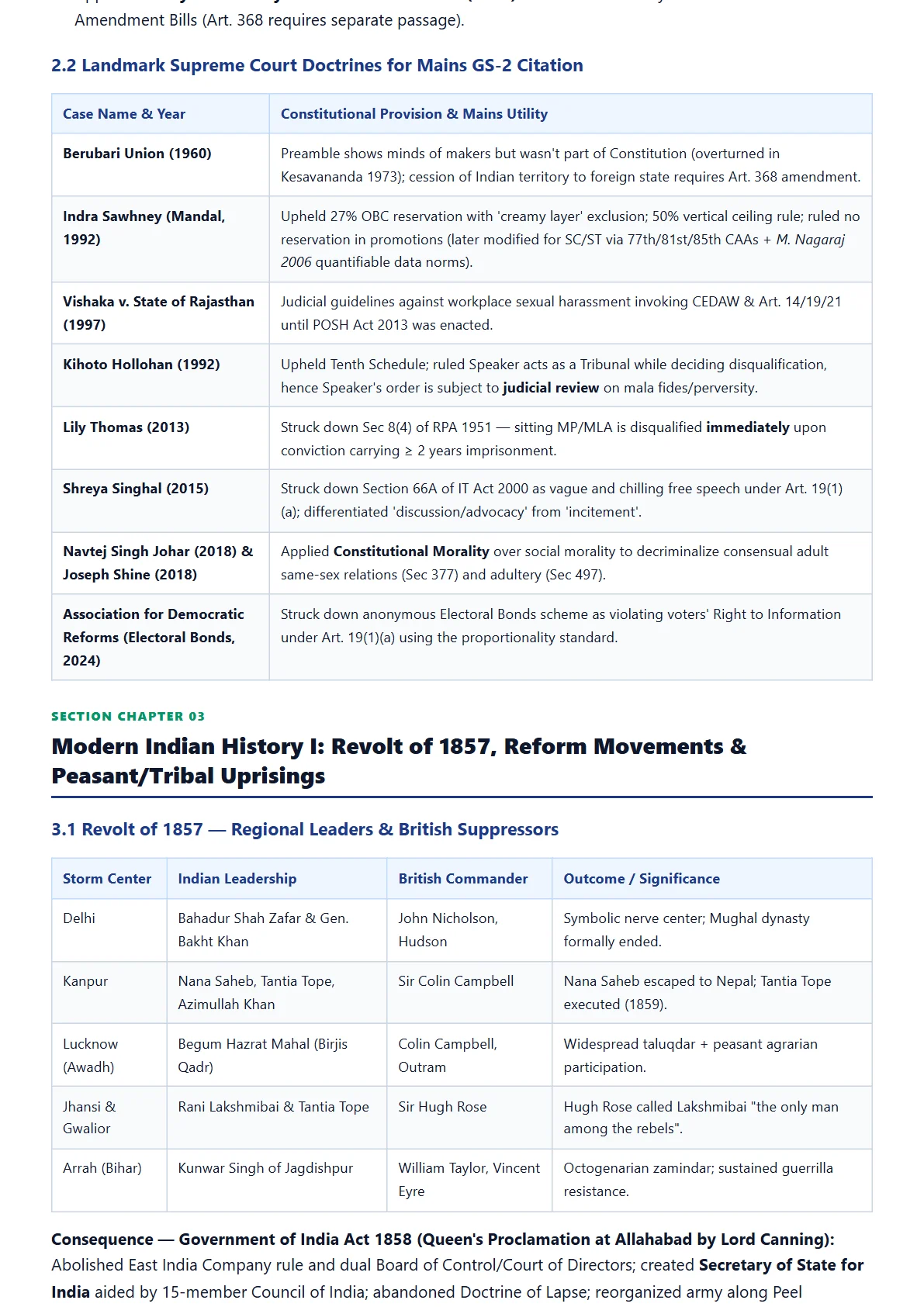
Continue Reading All 11 Full Pages Offline
Verify your email address to access the complete 11-page printable PDF with all chapters, tables, and solved examples.
In This Study Guide
- 1.1. Indian Polity & Constitutional Jurisprudence (Prelims + GS Paper 2)
- 2.2. Modern Indian History Chronology & Mass Movements (1857–1947 — GS Paper 1)
- 3.3. Indian Economy: Monetary Transmission, Fiscal Architecture & Agriculture (GS Paper 3)
- 4.4. Monsoon Mechanism, Global Environmental Conventions & GS-4 Ethics Blueprint
- 5.Complete PDF Chapter Breakdown
- 6.Frequently Asked Questions
Key Highlights
- Consolidated topic-wise written notes bridging Prelims factual precision and Mains 150/250-word analytical answer requirements across GS Papers 1, 2, 3, and 4
- Indian Polity & Constitution digest: Major Amendments, Parliamentary Accountability, Federalism Articles, and Landmark Supreme Court Doctrines (Kesavananda Bharati, Bommai, Puttaswamy)
- Modern Indian History (1857–1947): British Constitutional Acts comparison, INC Sessions matrix, Peasant/Tribal Uprisings, and Gandhian Mass Movements
- Indian Economy & Environment core concepts: RBI Monetary Policy tools, Fiscal Deficit formulas, BoP, CACP MSP methodology, Monsoon dynamics, Hotspots & COP/Ramsar conventions
- GS Paper 4 Ethics toolkit: Western & Indian Moral Thinkers, Foundational Civil Service Values, and a repeatable 6-Step Case Study Resolution Framework
Clearing the Union Public Service Commission Civil Services Examination (CSE) demands a decisive transition from passive reading of bulky reference textbooks to active, multi-revision consolidation. Aspirants who consistently clear Prelims cut-offs and score 420+ across General Studies Mains Papers 1 to 4 rely on crisp, syllabus-indexed UPSC written notes that pack constitutional articles, judicial doctrines, historical chronologies, economic transmission chains, ecological conventions, and ethical keywords onto high-recall revision sheets.
Unlike fragmented mind-maps that omit analytical context or 600-page transcripts that are impossible to revise in the five days between Prelims or Mains papers, well-structured written notes connect Prelims elimination traps (exact statutory bodies, amendment numbers, chronological order, committee recommendations) directly with Mains substantive arguments (constitutional morality, cooperative federalism, twin-balance-sheet dynamics, climate equity, and ethical probity). Below is a comprehensive subject-by-subject breakdown of the core conceptual pillars covered in this consolidated GS 1–4 revision dossier.
1. Indian Polity & Constitutional Jurisprudence (Prelims + GS Paper 2)
In UPSC Polity, factual articles must always be paired with constitutional philosophy and Supreme Court interpretation. Three interconnected pillars dominate both objective statements and 15-mark Mains questions:
- Structural Amendments to Remember: 42nd Amendment (1976) ('Mini-Constitution' — added Socialist, Secular, Integrity to Preamble; Part IVA Fundamental Duties under Swaran Singh Committee; shifted Education, Forests, Weights & Measures, Protection of Wild Animals and Administration of Justice to Concurrent List); 44th Amendment (1978) (replaced 'internal disturbance' with 'armed rebellion' under Art. 352; made Right to Property a constitutional right under Art. 300A; ensured Art. 20 & 21 cannot be suspended even during National Emergency); 52nd (1985) & 91st (2003) Amendments (Tenth Schedule Anti-Defection Law, removing the one-third split exemption and capping Council of Ministers at 15% of lower house strength); 73rd & 74th Amendments (1992) (constitutionalizing Panchayati Raj and Municipalities under Parts IX & IXA); 101st Amendment (2016) (GST & Art. 279A GST Council); and 106th Amendment (2023) (Nari Shakti Vandan Adhiniyam — one-third reservation for women in Lok Sabha and State Legislative Assemblies).
- Parliamentary Accountability & Federalism: Distinguish financial committees—Public Accounts Committee (22 members: 15 Lok Sabha + 7 Rajya Sabha, examines CAG audit reports), Estimates Committee (30 members solely from Lok Sabha, suggests economies in public expenditure), and Committee on Public Undertakings. In Centre-State relations, combine Articles 245–263 with Sarkaria (1983) and Punchhi (2007) Commission norms on Governor's discretionary restraint under Art. 163 and Art. 356.
| Landmark Supreme Court Case | Year | Core Constitutional Doctrine Established |
|---|---|---|
| Kesavananda Bharati v. State of Kerala | 1973 | Parliament's amending power under Art. 368 is wide but cannot alter the Basic Structure of the Constitution (13-judge bench). |
| Maneka Gandhi v. Union of India | 1978 | Read 'due process' fairness into Art. 21; established the Golden Triangle linking Articles 14, 19, and 21. |
| Minerva Mills v. Union of India | 1980 | Judicial review and harmony/balance between Fundamental Rights (Part III) and DPSPs (Part IV) are part of Basic Structure. |
| S.R. Bommai v. Union of India | 1994 | Federalism and Secularism are Basic Structure; President's Rule (Art. 356) is subject to judicial review and floor test is mandatory. |
| Justice K.S. Puttaswamy v. Union of India | 2017 | Right to Privacy is an intrinsic fundamental right under Art. 21; introduced the 3-fold proportionality test (legality, necessity, proportionality). |
2. Modern Indian History Chronology & Mass Movements (1857–1947 — GS Paper 1)
Modern History questions frequently test cause-and-effect linkages between British administrative enactments, agrarian distress, and nationalist mobilization:
- Constitutional Evolution Under Crown Rule: Indian Councils Act 1909 (Morley-Minto) introduced communal separate electorates for Muslims and allowed Satyendra Prasad Sinha into the Viceroy's Executive Council; Government of India Act 1919 (Montagu-Chelmsford) introduced Dyarchy in Provinces (Transferred vs Reserved subjects) and bicameralism at the Centre; Government of India Act 1935 abolished provincial dyarchy, granted Provincial Autonomy, proposed an All-India Federation (never operationalized), and established the Federal Court and RBI.
- Peasant & Tribal Resistance Matrix: Santhal Hul (1855–56, Sidhu & Kanhu) against zamindar-mahajan-British nexus in Damin-i-Koh; Indigo Revolt (1859–60, Digambar & Bishnu Biswas) portrayed in Dinabandhu Mitra's Nil Darpan; Munda Ulgulan (1899–1900, Birsa Munda) leading to Chotanagpur Tenancy Act 1908; Champaran Satyagraha (1917) against Tinkathia (3/20th land) indigo system; Bardoli Satyagraha (1928, Vallabhbhai Patel) against arbitrary land-revenue hike; and Tebhaga Movement (1946–47, Bengal Floud Commission demand for two-thirds crop share to bargadars).
- Defining INC Sessions: 1885 Bombay (W.C. Bonnerjee — 72 delegates); 1907 Surat Split (Rash Behari Ghosh); 1916 Lucknow Pact (Ambica Charan Mazumdar — Moderate-Extremist reunion & Congress-League pact); 1924 Belgaum (Mahatma Gandhi's sole presidency); 1929 Lahore (Jawaharlal Nehru — Purna Swaraj resolution); 1931 Karachi (Sardar Patel — Fundamental Rights & National Economic Programme); 1938 Haripura (Subhas Chandra Bose — National Planning Committee).
3. Indian Economy: Monetary Transmission, Fiscal Architecture & Agriculture (GS Paper 3)
UPSC Economy tests conceptual clarity on macroeconomic relationships rather than rote memorization of transient numbers. Keep the core accounting identities crystal clear:
1. Revenue Deficit = Revenue Expenditure − Revenue Receipts
2. Effective Revenue Deficit = Revenue Deficit − Grants for Creation of Capital Assets
3. Fiscal Deficit = Total Expenditure − (Revenue Receipts + Non-Debt Creating Capital Receipts)
4. Primary Deficit = Fiscal Deficit − Interest Obligations on Previous Borrowings
- RBI Monetary Policy Framework: Under the amended RBI Act 1934, the 6-member Monetary Policy Committee (MPC) targets headline CPI inflation at 4% ± 2%. Within the Liquidity Adjustment Facility (LAF) corridor, the Standing Deposit Facility (SDF) acts as the uncollateralized floor (25 bps below Repo Rate), Repo Rate is the policy benchmark, and Marginal Standing Facility (MSF) / Bank Rate serves as the ceiling (25 bps above Repo). During inflationary overheating, raising Repo Rate or Cash Reserve Ratio (CRR) absorbs excess banking liquidity.
- Balance of Payments (BoP) & Exchange Rate: Current Account comprises Trade in Goods (Visible) and Invisibles (Services, Investment Income, Remittances). Capital Account tracks FDI, FPI, External Commercial Borrowings (ECBs), and NRI deposits. Understand NEER (Nominal Effective Exchange Rate) vs REER (Real Effective Exchange Rate adjusted for domestic vs trading-partner inflation differentials; REER > 100 signals relative overvaluation of domestic currency, reducing export competitiveness).
- MSP Cost Concepts (CACP): Commission for Agricultural Costs and Prices recommends Minimum Support Prices for 22 mandated crops (plus Fair & Remunerative Price for sugarcane) using three cost definitions: A2 (actual out-of-pocket expenses by farmer on seeds, fertilizers, fuel, hired labor, leased-in land), A2 + FL (A2 plus imputed value of unpaid family labor), and C2 (comprehensive cost adding imputed rental value of owned land and interest on owned fixed capital over A2+FL).
4. Monsoon Mechanism, Global Environmental Conventions & GS-4 Ethics Blueprint
Geography & Ecology (GS-1 & GS-3): The Indian Southwest Monsoon is governed by the northward summer shift of the Inter-Tropical Convergence Zone (ITCZ / Monsoon Trough) over the Gangetic plain, intense sensible heating of the Tibetan Plateau generating the Tropical Easterly Jet (TEJ), withdrawal of the Sub-Tropical Westerly Jet north of the Himalayas, and Mascarene High cross-equatorial flow. Inter-annual variability is modulated by ENSO (El Niño suppresses Indian rainfall via Walker Circulation shift; La Niña enhances it) and the Indian Ocean Dipole (IOD), where a Positive IOD (warmer western Indian Ocean off East Africa relative to eastern Indian Ocean off Sumatra) counteracts El Niño deficits. In Ecology, revise India's 4 Biodiversity Hotspots (Himalaya, Indo-Burma, Western Ghats–Sri Lanka, and Sundaland/Nicobar), the Montreux Record under the Ramsar Convention (currently Keoladeo National Park and Loktak Lake from India; Chilika Lake was removed after restoration), and the Kunming-Montreal Global Biodiversity Framework (30×30 target).
GS Paper 4 Ethics & Case Study Approach: Pair foundational civil service values defined by the Nolan Committee (Selflessness, Integrity, Objectivity, Accountability, Openness, Honesty, Leadership) with philosophical anchors—Aristotle's Golden Mean, Immanuel Kant's Categorical Imperative (treating humanity never merely as a means, always as an end), John Stuart Mill's Utilitarianism, Gandhi's Talisman (recall the face of the poorest and weakest person), and Kautilya's Yogakshema. For every 20-mark Case Study, deploy a disciplined 6-step structure: (1) Core Ethical Dilemma Statement, (2) Stakeholder Matrix, (3) Constitutional/Legal/Service Conduct Rules Involved, (4) Evaluation of 3 Options (Merits & Demerits), (5) Pragmatic Course of Action (Short-term relief + Long-term institutional reform), and (6) Principled Conclusion.
What’s Included Inside the Complete 11-Page PDF
Structured specifically for fast revision, exam hall recall, and clean A4 printing:
GS-2 Indian Polity, Governance & Landmark Judgments
Constitutional Amendments (1st to 106th key milestones), Fundamental Rights vs DPSP harmony, Parliamentary Committees, Anti-Defection Law, and 15 defining Supreme Court verdicts.
GS-1 Modern Indian History (1857–1947) Master Chronology
Revolt of 1857 centers, Socio-Religious Reformers, Peasant & Tribal Movements, Councils Acts (1909/1919/1935), Historic INC Sessions, and Freedom Struggle phases.
GS-3 Indian Economy: Monetary, Fiscal, BoP & Agriculture
MPC Repo/SDF/MSF corridor, Deficit accounting equations, FRBM framework, Current vs Capital Account convertibility, and MSP (A2, A2+FL, C2) mechanics.
GS-1 & GS-3 Geography, Monsoon & Global Ecology Conventions
ITCZ, Jet Streams, ENSO & Indian Ocean Dipole impact on Indian Monsoon; 4 Indian Biodiversity Hotspots; Ramsar, CITES, CMS, CBD Kunming-Montreal & UNFCCC COP milestones.
GS-4 Ethics, Moral Philosophers & Case Study Blueprint
Aristotle, Kant, Mill, Rawls, Kautilya, Buddha, Gandhi & Tagore ethical frameworks alongside stakeholder mapping and administrative dilemma resolution steps.
Ready to download the full 11-page printable PDF?
Instant access + backup copy delivered straight to your verified email address.
Frequently Asked Questions
How are these UPSC Written Notes different from standard bulky textbooks?+
Standard textbooks like Laxmikanth, Spectrum, or Ramesh Singh span thousands of pages designed for first-time reading. These topic-wise written notes condense high-probability Prelims traps, comparative tables, constitutional articles, Supreme Court case doctrines, and Mains analytical dimensions into rapid-revision chapters.
Do these written notes cover both UPSC Prelims and Mains GS Papers 1 to 4?+
Yes. Every chapter integrates factual precision required for Prelims statement elimination (amendment numbers, chronological sequences, convention protocols, RBI/CACP definitions) alongside multi-dimensional arguments, committee names, and case-study frameworks required for Mains GS Papers 1, 2, 3, and 4.
Are these notes also useful for State PCS exams like UPPSC, BPSC, MPPSC, and RAS?+
Absolutely. State Public Service Commission Prelims and Mains syllabi mirror UPSC General Studies closely, especially on Constitutional Amendments, Modern History chronology (1857–1947), Five-Year/NITI fiscal concepts, Monsoon geography, Ecological conventions, and GS Ethics.
How should an aspirant use these notes during the final 30 days before the exam?+
Use active recall: cover the right-hand explanation column of Landmark Judgments, British Acts, INC Sessions, and Environmental Conventions tables, test yourself on exact years/articles/provisions, and annotate your own PYQ error points in the margins.
Does the GS-4 Ethics section include thinkers as well as practical case study solving steps?+
Yes. Chapter 8 of the PDF provides crisp exam-ready summaries of Western and Indian moral thinkers, foundational bureaucratic values, emotional intelligence dimensions, and a step-by-step template for 20-mark administrative case studies.
Editorial Accuracy & Syllabus Verification (2026–27)
This guide was compiled by Siddharth Deshmukh (Civil Services Faculty & Mains Evaluative Mentor (3× UPSC CSE Interview Appeared)) and reviewed by Dr. Kavita Krishnan Iyer (Public Policy Researcher & General Studies Curriculum Reviewer) in accordance with our Editorial Policy. Found a syllabus update or typo? Write to support@allindiapdf.com.