Class 12 Physics Notes: Complete 14-Chapter NCERT Revision Guide, Derivations & Formula Sheet
English Medium CBSE & NCERT Class 12 Physics chapter-wise summary covering step-by-step board derivations, circuit & ray diagram logic, SI dimensional tables, and numerical checklists.
Get the complete formatted PDF right in your inbox & instant browser download.
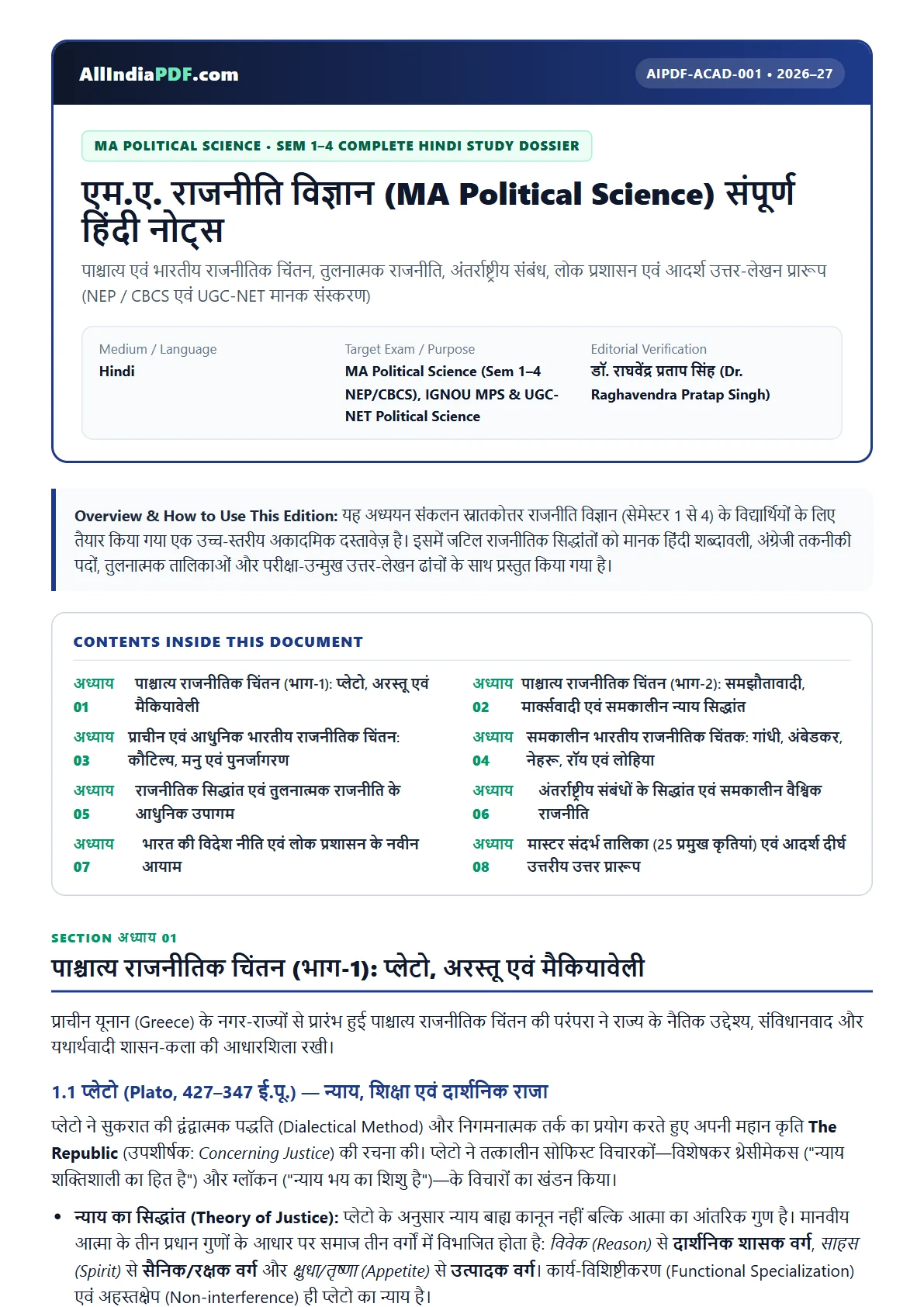
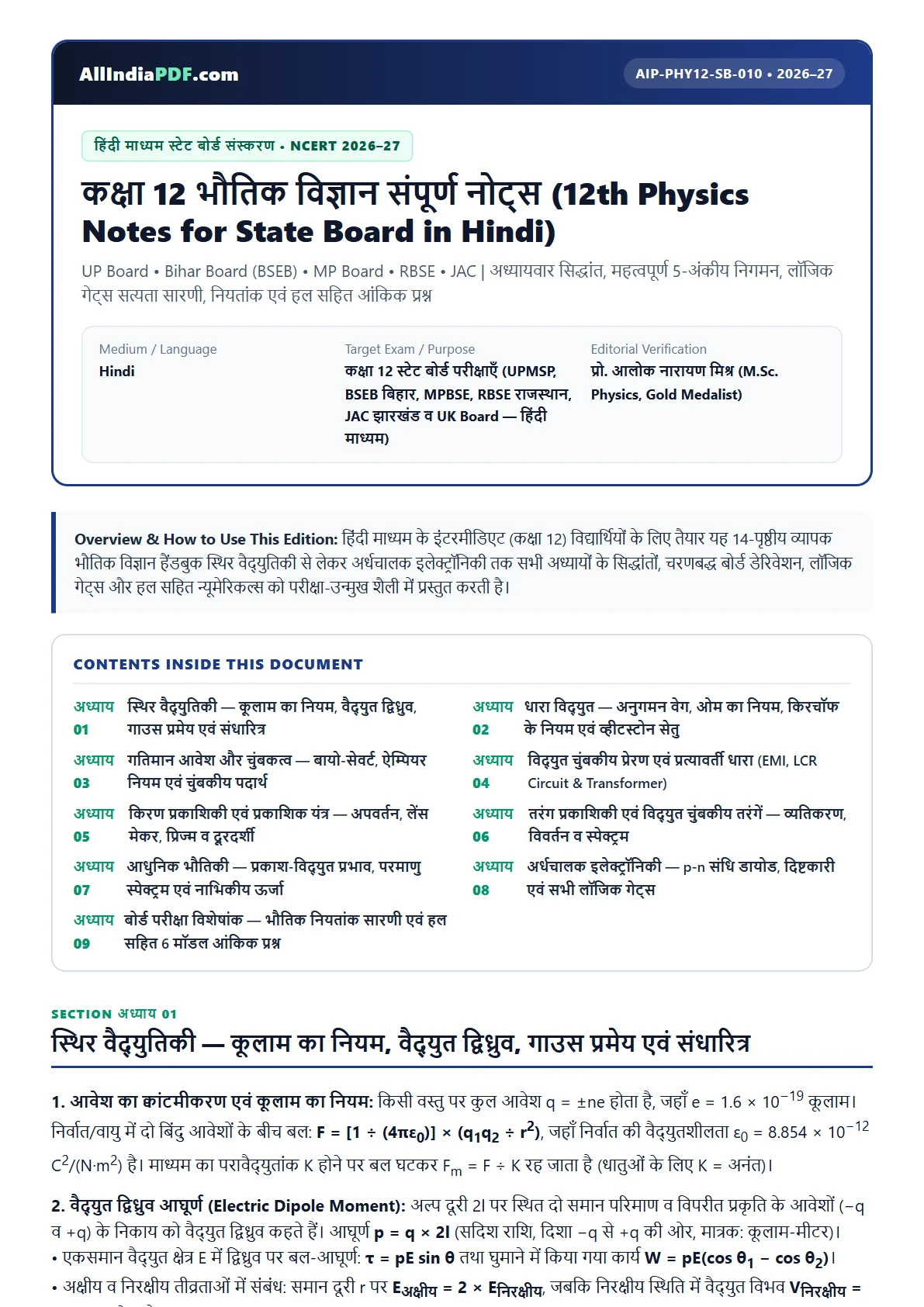
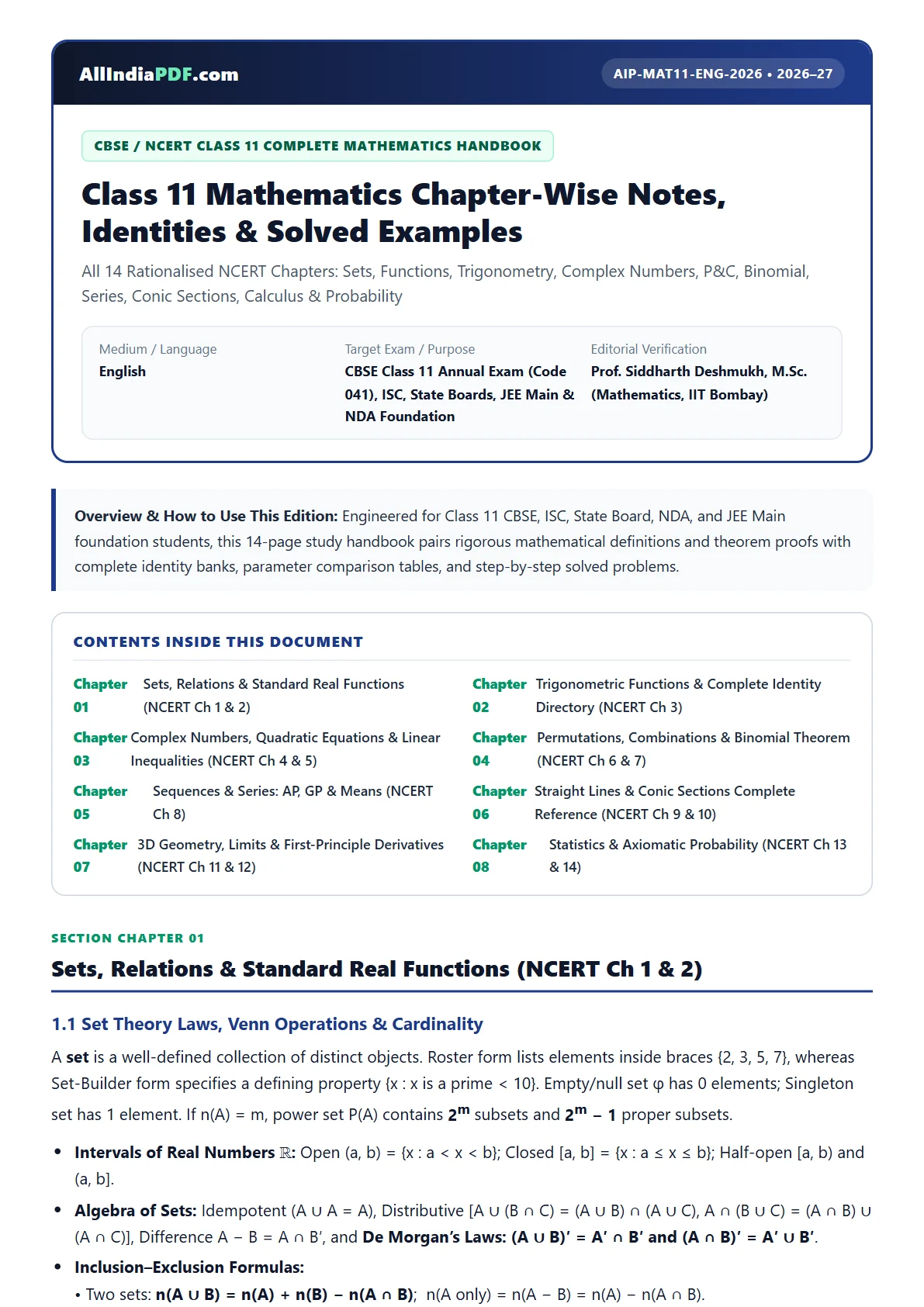
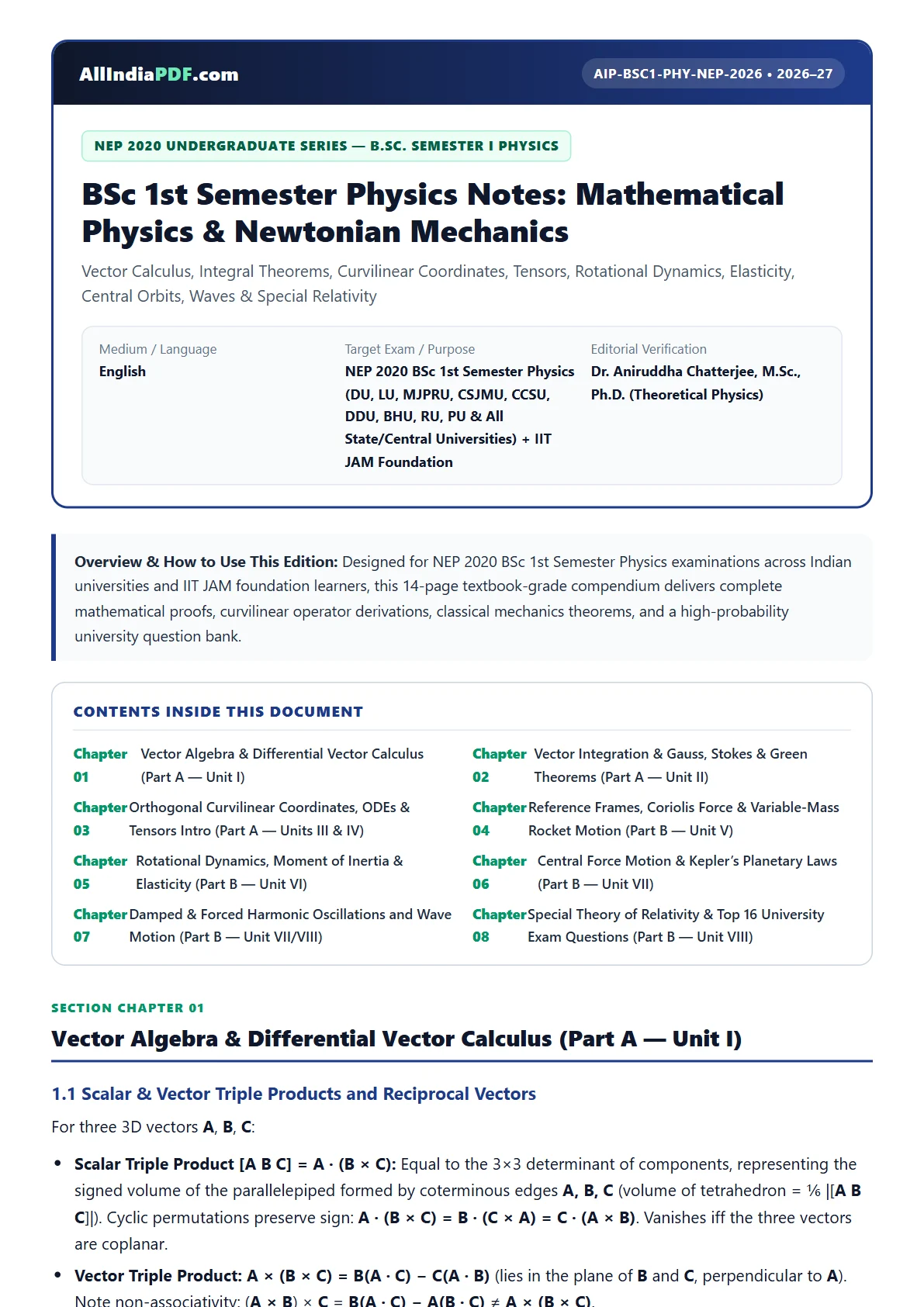
Inside Document Preview (Pages 1–3 of 15)
Actual print-ready pages from the verified 2026–27 PDF compilation.
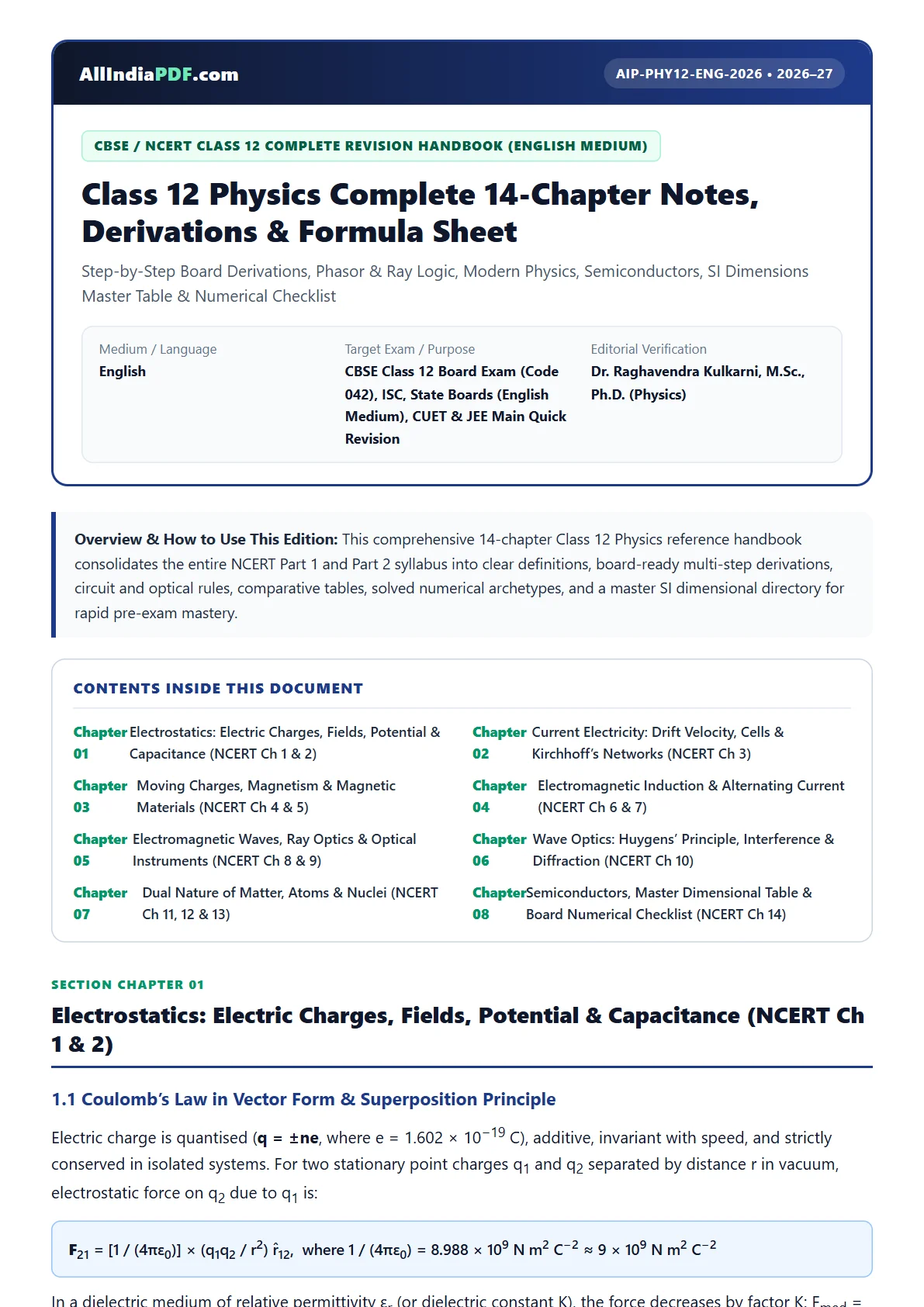
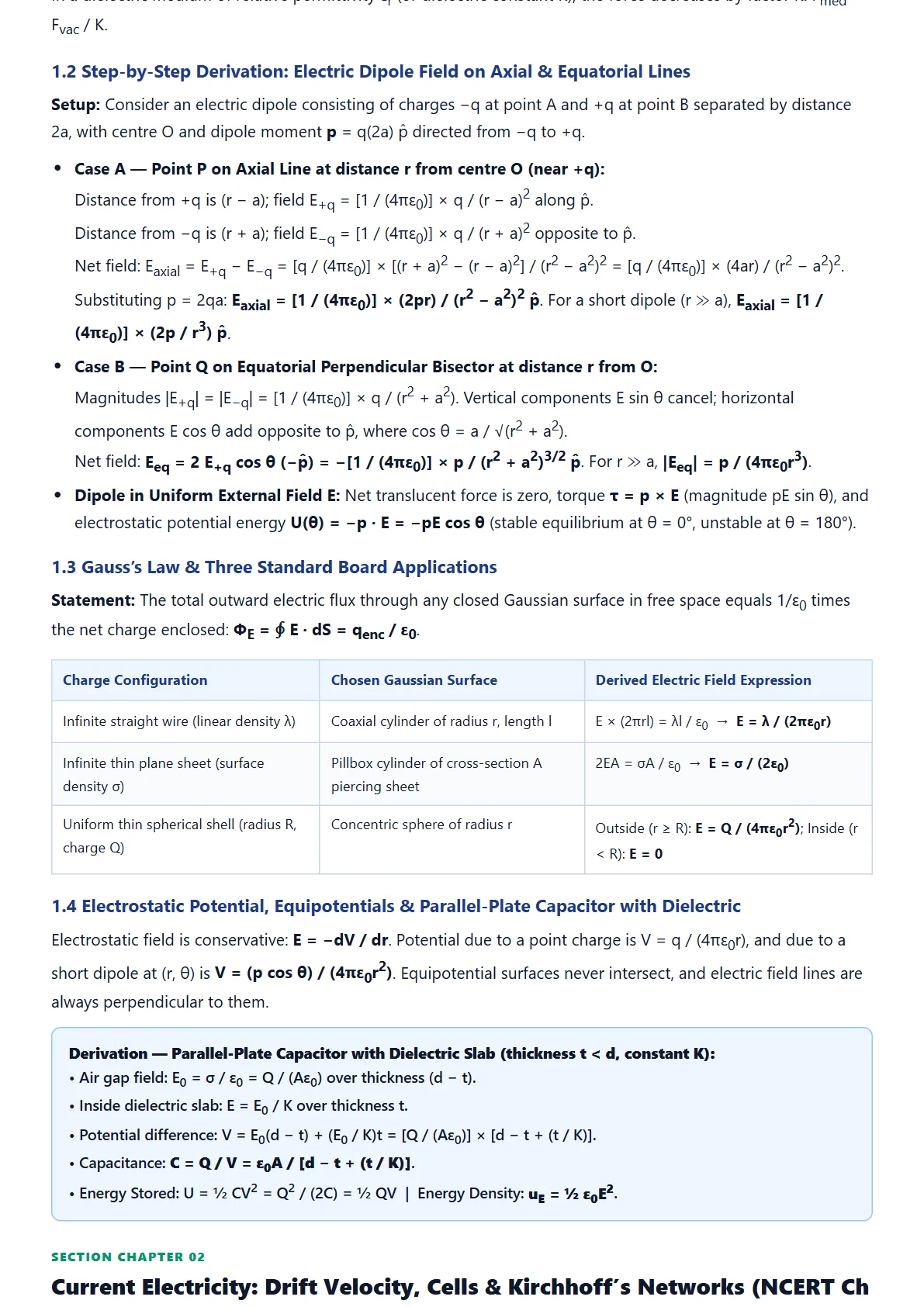
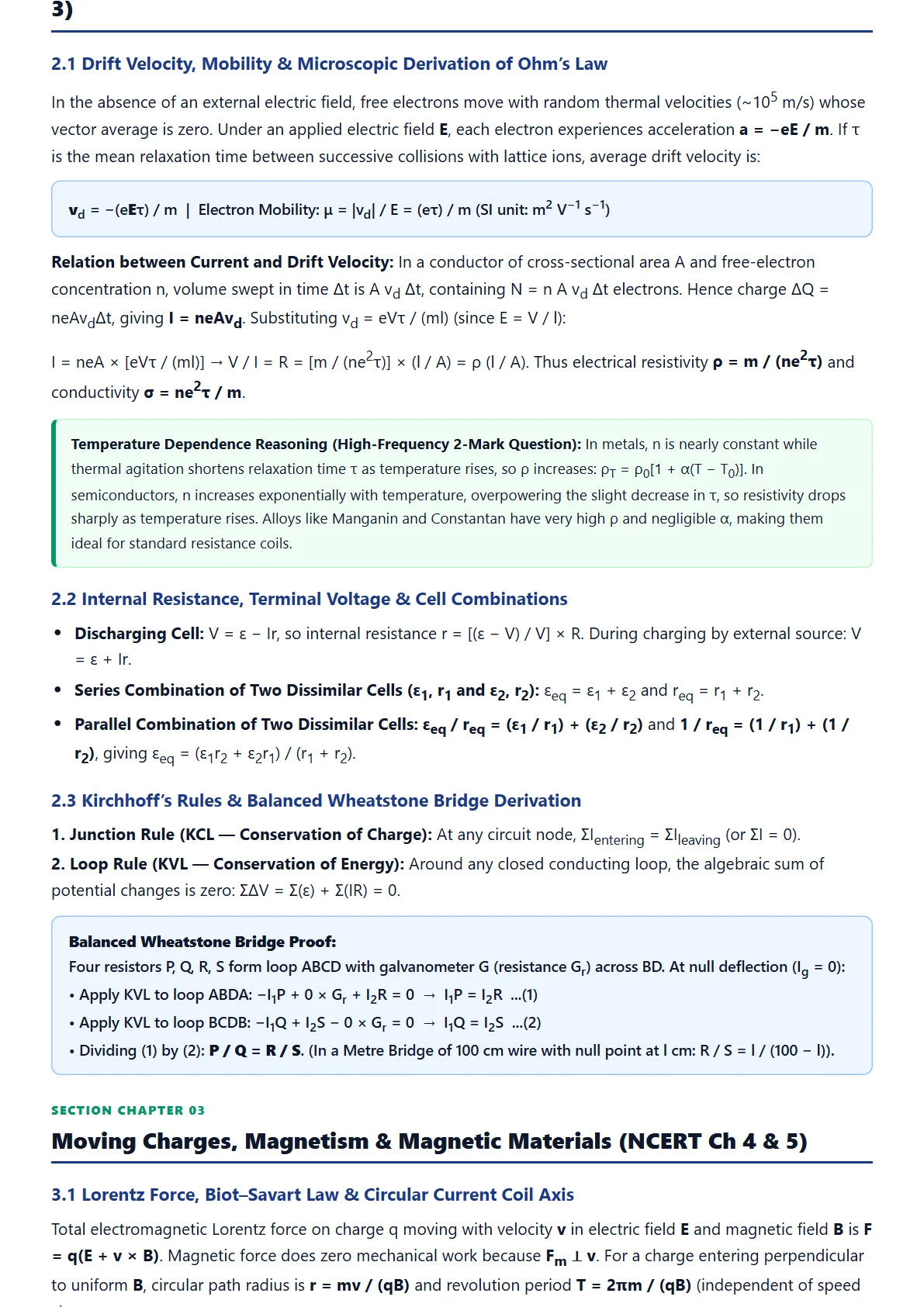
Continue Reading All 15 Full Pages Offline
Verify your email address to access the complete 15-page printable PDF with all chapters, tables, and solved examples.
In This Study Guide
- 1.1. CBSE Class 12 Physics Syllabus Weightage & High-Yield Derivations Map
- 2.2. Electrostatics, Current Electricity & Magnetism Master Formula Sheet
- 3.3. Alternating Current (LCR), Ray Optics & Wave Optics Essential Relations
- 4.4. Modern Physics, Semiconductors & Fundamental Constants Table
- 5.Complete PDF Chapter Breakdown
- 6.Frequently Asked Questions
Key Highlights
- Covers all 14 rationalised NCERT Class 12 Physics chapters across Units I to IX in crisp English
- Step-by-step 3-mark and 5-mark board derivations with explicit vector directions and boundary assumptions
- Complete formula bank for Electrostatics, Current Electricity, Magnetism, LCR Resonance, Optics & Modern Physics
- Master table of 30+ physical quantities with SI units, CGS equivalents, and dimensional formulas
- Dedicated Competency-Based Case Study and numerical sign-convention checklist to prevent common board errors
Scoring above 90% in the CBSE Class 12 Physics (Subject Code 042) theory paper requires a balanced command over three distinct pillars: rigorous multi-step derivations, conceptual reasoning for Competency-Based Questions (CBQs), and fast, unit-consistent numerical problem solving. Unlike rote-memorised subjects, Class 12 Physics rewards students who understand how foundational laws—such as Gauss’s Law in electrostatics, Ampere’s Circuital Law in magnetism, Huygens’ wavefront construction in wave optics, and Bohr’s quantisation condition in atomic physics—connect across chapters.
These Class 12 Physics Notes are structured strictly around the latest rationalised NCERT Part 1 and Part 2 textbooks for English-medium students preparing for CBSE, ISC, English-medium State Boards, CUET (UG), and JEE Main revision. Below on this page, you can study the complete unit-wise marks distribution, essential board formulas, sign conventions, and fundamental dimensional tables before accessing the printable 14-chapter A4 study handbook.
1. CBSE Class 12 Physics Syllabus Weightage & High-Yield Derivations Map
Planning revision around official unit groupings prevents spending excessive hours on low-weightage subtopics while neglecting 18-mark Optics or 16-mark Electrostatics + Current Electricity blocks. Use the blueprint table below to prioritise your revision schedule:
| Unit & NCERT Chapters | Board Marks | Top Priority Derivations & Core Concepts |
|---|---|---|
| Units I & II: Electric Charges & Fields, Electrostatic Potential & Capacitance, Current Electricity (Ch 1–3) | 16 Marks | Dipole axial & equatorial field, Gauss’s Law (infinite wire, plane sheet, spherical shell), parallel-plate capacitor with dielectric, drift velocity & resistivity, Wheatstone bridge balance. |
| Units III & IV: Moving Charges & Magnetism, Magnetism & Matter, EMI, Alternating Current (Ch 4–7) | 17 Marks | Magnetic field on circular loop axis (Biot–Savart), force between parallel currents, moving-coil galvanometer, mutual inductance of coaxial solenoids, series LCR impedance & resonance, AC generator & transformer. |
| Units V & VI: Electromagnetic Waves, Ray Optics & Optical Instruments, Wave Optics (Ch 8–10) | 18 Marks | EM wave spectrum properties, spherical surface refraction, Lens Maker’s formula, prism minimum deviation, compound microscope & astronomical telescope, Snell’s law via Huygens’ principle, Young’s double-slit & single-slit diffraction. |
| Units VII & VIII: Dual Nature of Radiation & Matter, Atoms, Nuclei (Ch 11–13) | 12 Marks | Einstein’s photoelectric equation & stopping-potential graphs, de Broglie wavelength of electron, Bohr’s radius/energy derivations, Hydrogen spectral series, mass defect & binding energy per nucleon curve. |
| Unit IX: Semiconductor Electronics — Materials, Devices & Simple Circuits (Ch 14) | 07 Marks | Energy band diagrams (conductors, insulators, semiconductors), p–n junction depletion formation, forward & reverse bias V–I curves, half-wave and centre-tap full-wave rectifiers. |
2. Electrostatics, Current Electricity & Magnetism Master Formula Sheet
Book 1 of NCERT Class 12 Physics revolves around electric and magnetic fields, potentials, steady currents, and time-varying fluxes. Keep these core vector magnitudes and scalar relations sharp for 1-mark MCQs and 3-mark numericals:
• Axial Line: Eaxial = (1 / 4πε0) × (2p / r3) (along dipole moment vector p)
• Equatorial Line: Eeq = (1 / 4πε0) × (p / r3) (antiparallel to p; note Eaxial = 2 Eeq)
• Torque in Uniform Field: τ = pE sin θ | Potential Energy: U = −pE cos θ
- Gauss’s Theorem in Electrostatics: Total outward electric flux ΦE = ∮ E · dS = qenclosed / ε0. For an infinitely long uniform line charge of linear density λ, E = λ / (2πε0r); for an infinite thin non-conducting plane sheet of surface density σ, E = σ / (2ε0) (independent of distance r).
- Parallel-Plate Capacitor with Partial Dielectric Slab: When a dielectric slab of thickness t (t < d) and dielectric constant K is inserted between plates of area A separated by distance d, the capacitance becomes C = ε0A / [d − t + (t / K)]. When completely filled (t = d), C = Kε0A / d.
- Drift Velocity & Microscopic Ohm’s Law: Drift speed vd = (eEτ) / m, electric current I = neAvd, current density J = σcE, and electrical resistivity ρ = m / (ne2τ), where n is free-electron number density and τ is average relaxation time.
- Biot–Savart Circular Current Loop & Solenoid: Along the axis of a circular coil of N turns, radius R, carrying current I at axial distance x: B = (μ0NIR2) / [2(R2 + x2)3/2]. Inside a long solenoid of n turns per unit length: B = μ0nI.
- Parallel Current Conductors: Force per unit length between two long parallel wires separated by distance d carrying currents I1 and I2 is f = (μ0I1I2) / (2πd)—attractive for parallel currents and repulsive for antiparallel currents.
3. Alternating Current (LCR), Ray Optics & Wave Optics Essential Relations
Alternating Current and Optics together carry nearly half of the entire theory paper. Pay close attention to Cartesian sign conventions in Ray Optics and phase-angle relationships in AC circuits:
• Impedance: Z = √[R2 + (XL − XC)2], where XL = ωL and XC = 1 / (ωC)
• Phase Angle: tan φ = (XL − XC) / R | Average Power: Pavg = Vrms Irms cos φ
• Resonance Condition (XL = XC): ω0 = 1 / √(LC), Zmin = R, Quality Factor Q = (ω0L) / R = (1 / R) √(L / C)
In Ray Optics, all distances are measured from the optical centre or pole, taking the direction of incident light as positive:
- Refraction at a Single Spherical Surface: (n2 / v) − (n1 / u) = (n2 − n1) / R, where light travels from medium n1 into medium n2.
- Lens Maker’s Formula & Thin Lens Equation: 1 / f = (n21 − 1) [(1 / R1) − (1 / R2)] = (1 / v) − (1 / u). Note that for a double convex lens, R1 is positive and R2 is negative.
- Prism Minimum Deviation Formula: Refractive index n = sin[(A + δm) / 2] ÷ sin(A / 2), valid when angle of incidence i equals angle of emergence e and the refracted ray inside the prism runs parallel to its base.
- Young’s Double-Slit Interference vs Single-Slit Diffraction: In YDSE, all bright and dark fringes share equal fringe width β = λD / d, with resultant intensity I = 4I0 cos2(φ / 2). In single-slit Fraunhofer diffraction (slit width a), the central bright maximum has linear width W0 = 2λD / a—twice as wide as secondary maxima—with rapidly decaying intensity peaks.
4. Modern Physics, Semiconductors & Fundamental Constants Table
Units VII, VIII, and IX offer the highest marks-per-page return in Class 12 Physics because derivations are compact and numericals follow predictable substitutions:
• Einstein’s Photoelectric Equation: Kmax = eV0 = hν − φ0 = h(ν − ν0)
• de Broglie Wavelength of Accelerated Electron: λ = h / √(2meV) ≈ 1.227 / √V nm
• Bohr’s Hydrogen-Like Orbit: rn = 0.529 × (n2 / Z) Å | En = −13.6 × (Z2 / n2) eV
• Mass Defect & Nuclear Binding Energy: Δm = [Z mp + (A − Z) mn − Mnucleus], BE = Δm × 931.5 MeV/u
In Semiconductor Electronics (Chapter 14), remember the mass-action law ne × nh = ni2, valid at thermal equilibrium for both intrinsic and doped (n-type pentavalent P/As/Sb and p-type trivalent B/Al/In) semiconductors. In a half-wave rectifier, output ripple frequency equals input AC frequency (50 Hz), whereas in a full-wave rectifier, output ripple frequency doubles to 2ν (100 Hz).
| Physical Quantity / Constant | Standard Value / SI Unit | Dimensional Formula |
|---|---|---|
| Permittivity of Free Space (ε0) | 8.854 × 10⁻¹² C2 N−1 m−2 | [M−1 L−3 T4 A2] |
| Permeability of Free Space (μ0) | 4π × 10−7 T m A−1 | [M1 L1 T−2 A−2] |
| Magnetic Flux (ΦB) | Weber (Wb = T m2) | [M1 L2 T−2 A−1] |
| Self / Mutual Inductance (L, M) | Henry (H = Wb A−1) | [M1 L2 T−2 A−2] |
| Planck’s Constant (h) | 6.626 × 10⁻³⁴ J s | [M1 L2 T−1] |
What’s Included Inside the Complete 15-Page PDF
Structured specifically for fast revision, exam hall recall, and clean A4 printing:
Electrostatics, Gauss’s Law & Capacitance Derivations
Axial and equatorial electric dipole fields, Gauss’s theorem applications, equipotential properties, and parallel-plate capacitor with partial or full dielectric slab.
Current Electricity, Moving Charges & Magnetism
Drift velocity and Ohm’s law microscopic proof, Kirchhoff’s junction and loop analysis, Wheatstone bridge, Biot–Savart circular coil axis field, and moving-coil galvanometer.
EMI, Alternating Current & Phasor Resonance Summary
Faraday–Lenz induction, self and mutual inductance of solenoids, series LCR impedance triangle, resonance sharpness (Q-factor), power factor, and transformer losses.
Ray Optics, Wave Optics, Modern Physics & Semiconductors
Lens Maker’s formula, prism refraction, microscope/telescope angular magnification, Young’s double-slit interference, Einstein’s photoelectric equation, Bohr’s model, nuclear binding energy, and p–n junction rectifiers.
Ready to download the full 15-page printable PDF?
Instant access + backup copy delivered straight to your verified email address.
Frequently Asked Questions
Do these Class 12 Physics notes follow the latest rationalised NCERT and CBSE syllabus?+
Yes. All 14 chapters follow the current rationalised NCERT Class 12 Physics curriculum (Part 1: Chapters 1–8 and Part 2: Chapters 9–14), omitting deleted topics such as Van de Graaff generator, carbon resistor colour codes, potentiometer numericals where excluded, cyclotron, Earth’s magnetic elements derivations, resolving power, Davisson–Germer experiment, radioactive decay law derivations, and transistors/logic gates, while keeping concise conceptual bridges where helpful for CUET and JEE Main.
Are step-by-step derivations included for 3-mark and 5-mark board questions?+
Yes. Every major long-answer derivation—including Axial and Equatorial Dipole Field, Gauss’s Law applications, Parallel-Plate Capacitor with Dielectric, Drift Velocity, Biot–Savart Circular Coil Axis Field, Series LCR Impedance, Lens Maker’s Formula, Prism Formula, Young’s Double-Slit Interference, and Bohr’s Orbit Energy—is presented step by step with introductory assumptions, intermediate substitutions, and boxed final expressions.
How are these notes different from Hindi-medium state board physics notes?+
This study guide is authored completely in crisp academic English tailored for CBSE (Code 042), ISC, Kendriya Vidyalaya, Navodaya, and English-medium State Board students, aligning strictly with CBSE marking-scheme keywords, competency-based case-study logic, and SI unit conventions.
Which units carry the highest weightage in Class 12 Physics board exams?+
Unit VI (Optics — Ray Optics and Wave Optics) together with Unit V (EM Waves) carries the single largest block of 18 marks, followed closely by Units III & IV (Magnetism, EMI & Alternating Current) at 17 marks, and Units I & II (Electrostatics & Current Electricity) at 16 marks.
How should I avoid losing half-marks in Class 12 Physics derivations and numericals?+
Always draw arrow heads on every light ray in Ray Optics, mark current directions in Kirchhoff loops, state vector directions alongside magnitudes in Electrostatics and Magnetism, convert centimetres/millimetres/microfarads/electron-volts into pure SI units before substitution, and write the standard SI unit at the end of every numerical answer.
Editorial Accuracy & Syllabus Verification (2026–27)
This guide was compiled by Dr. Raghavendra Kulkarni, M.Sc., Ph.D. (Physics) (Senior Post-Graduate Physics Educator (16+ Years CBSE Board Evaluation Experience)) and reviewed by Prof. Meenakshi Sundaram, M.Sc. (IIT Madras) (Academic Curriculum Reviewer — Senior Secondary Sciences) in accordance with our Editorial Policy. Found a syllabus update or typo? Write to support@allindiapdf.com.