Maths Notes for Class 11 PDF Free Download: Complete NCERT Chapter-Wise Formulas, Identities & Solved Examples
Instant on-page Class 11 Mathematics formula reference sheet plus complete 14-chapter study notes covering Sets, Trigonometry, Algebra, Conic Sections, Limits, Derivatives & Probability.
Get the complete formatted PDF right in your inbox & instant browser download.
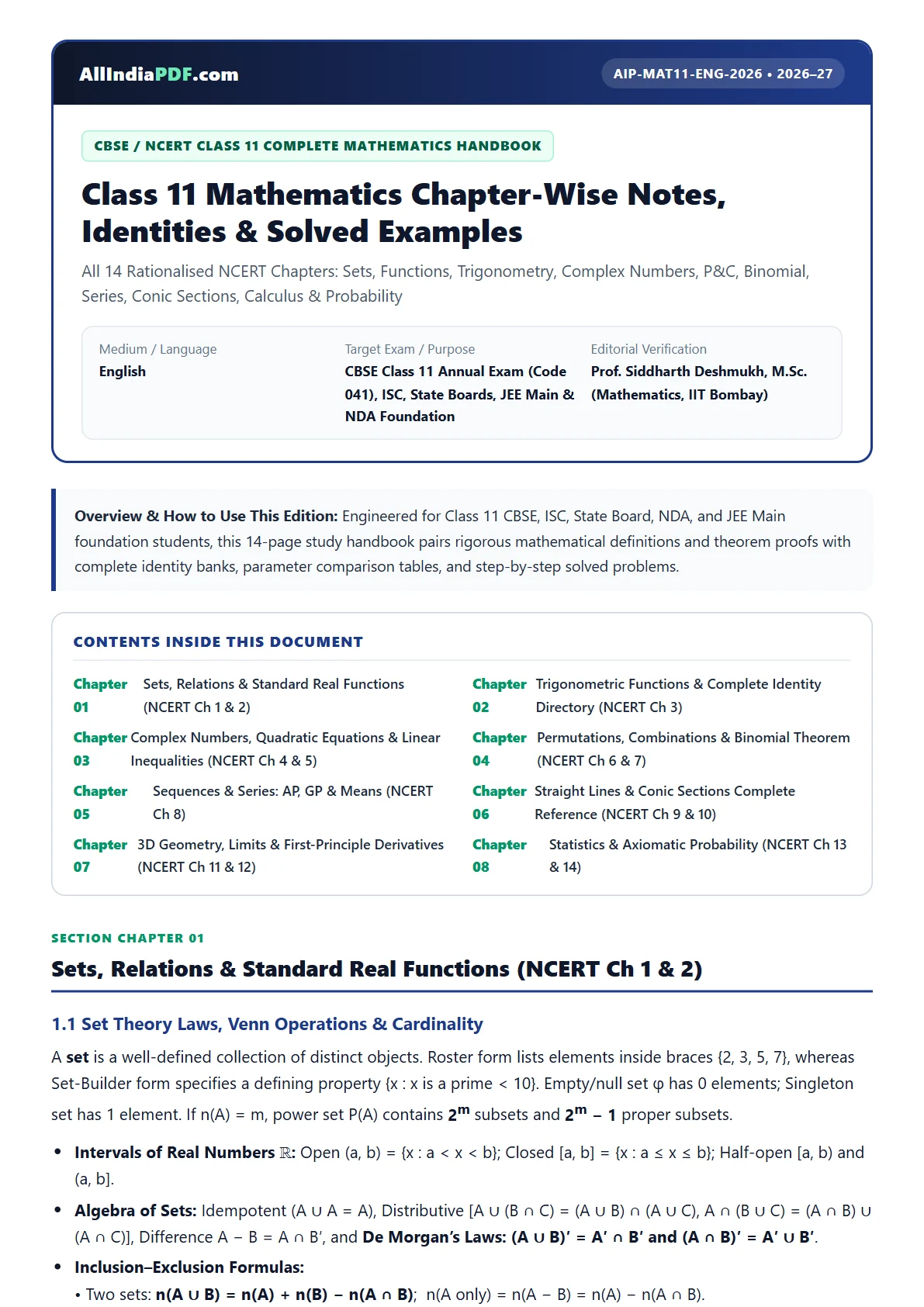
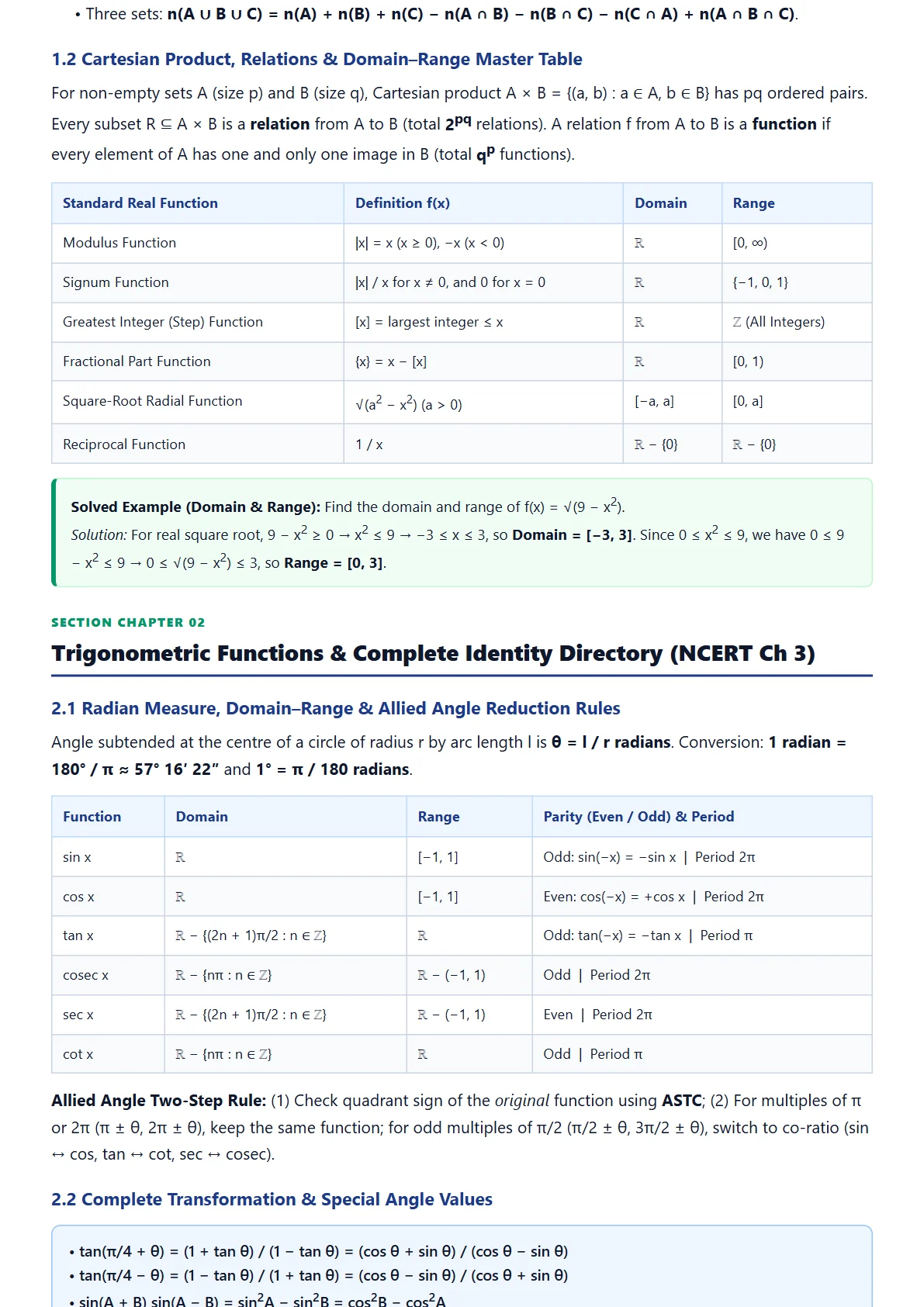
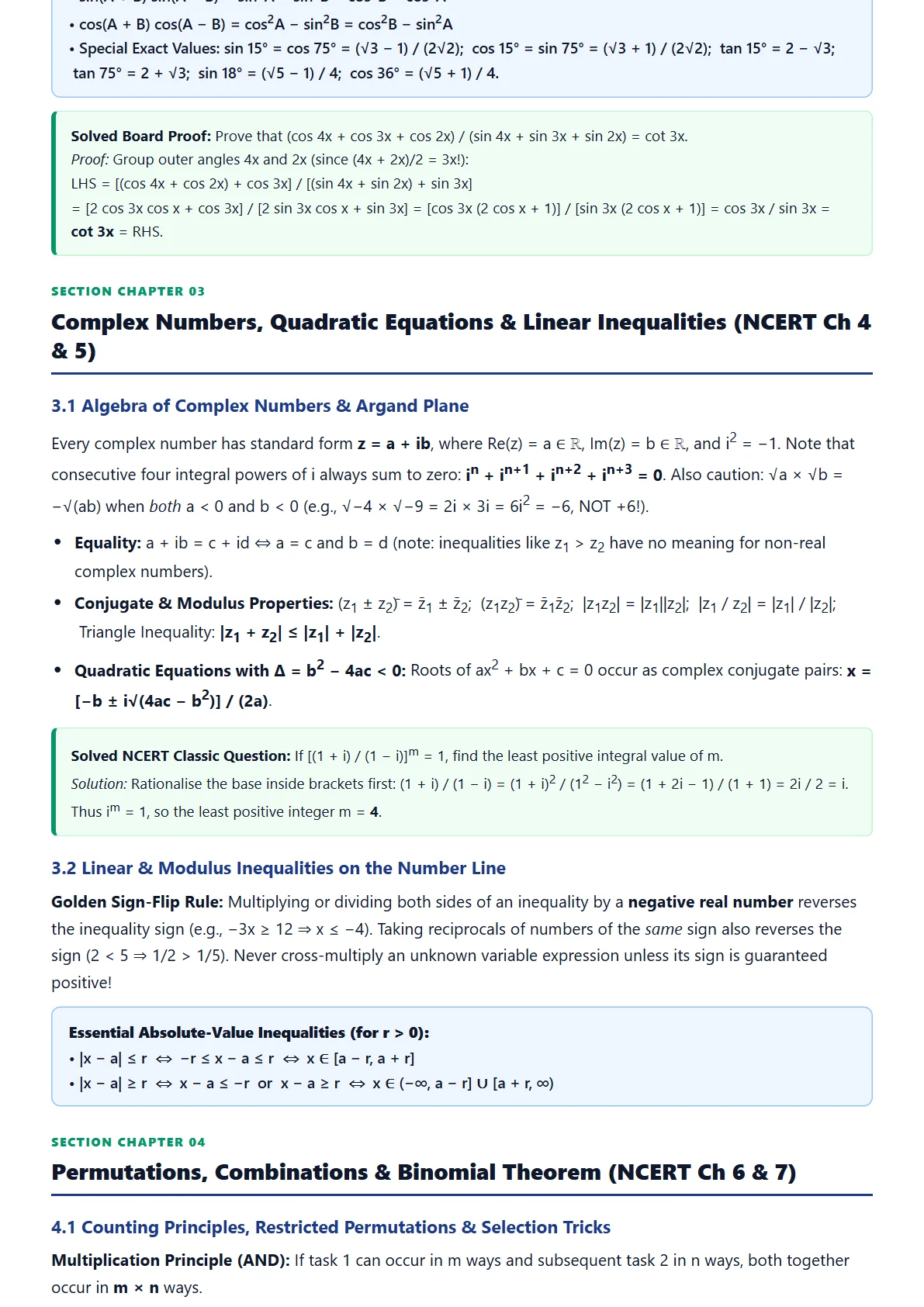
Inside Document Preview (Pages 1–3 of 9)
Actual print-ready pages from the verified 2026–27 PDF compilation.
Continue Reading All 9 Full Pages Offline
Verify your email address to access the complete 9-page printable PDF with all chapters, tables, and solved examples.
In This Study Guide
- 1.1. CBSE Class 11 Mathematics Syllabus & Unit-Wise Blueprint (80 + 20 Marks)
- 2.2. Free Quick-Reference Sheet: Trigonometric Functions & Transformation Identities
- 3.3. Sets, Complex Numbers, P&C, Binomial Theorem & Sequences Quick Sheet
- 4.4. Conic Sections Master Table & First-Principle Limits / Derivatives
- 5.Complete PDF Chapter Breakdown
- 6.Frequently Asked Questions
Key Highlights
- Includes an instant on-page Quick-Reference Formula Summary for immediate revision alongside the multi-page printable PDF
- Covers all 14 rationalised NCERT Class 11 Mathematics chapters from Sets & Relations to Statistics & Probability
- Complete bank of 35+ Trigonometric transformation, compound-angle, double-angle, and triple-angle identities
- Side-by-side Conic Sections Master Table comparing Circle, Parabola, Ellipse, and Hyperbola parameters
- Step-by-step First Principle derivative proofs, P&C counting strategies, and solved NCERT/Exemplar problems
The jump from Class 10 Mathematics to Class 11 Mathematics (CBSE Code 041) is widely recognised by educators as the single steepest conceptual transition in school academics. Students move rapidly from concrete arithmetic and basic mensuration into abstract set notation, 35+ trigonometric transformation identities, combinatorics, complex algebra, analytical conic sections, and the foundations of differential calculus. Strong command over Class 11 chapters is also decisive for Class 12 Relations/Calculus and accounts for roughly 45–50% of JEE Main and NDA mathematics questions.
If you searched for maths notes for class 11 pdf free download, we have built a complete instant-access Quick-Reference Formula Summary directly onto this web page—including the official unit blueprint, all Trigonometric identities, Algebra rules, Conic Sections comparison tables, and Calculus limit/derivative formulas—so you can revise right away, plus a printable 14-page complete chapter-wise handbook containing worked proofs and solved exam problems.
1. CBSE Class 11 Mathematics Syllabus & Unit-Wise Blueprint (80 + 20 Marks)
The rationalised NCERT Class 11 Mathematics textbook contains 14 chapters grouped into five core units for an 80-mark annual theory exam and 20-mark internal assessment:
| Unit Name | Included NCERT Chapters | Annual Weightage |
|---|---|---|
| Unit I: Sets and Functions | Ch 1: Sets | Ch 2: Relations & Functions | Ch 3: Trigonometric Functions | 23 Marks |
| Unit II: Algebra | Ch 4: Complex Numbers & Quadratic Equations | Ch 5: Linear Inequalities | Ch 6: Permutations & Combinations | Ch 7: Binomial Theorem | Ch 8: Sequences & Series | 25 Marks |
| Unit III: Coordinate Geometry | Ch 9: Straight Lines | Ch 10: Conic Sections | Ch 11: Introduction to Three-Dimensional Geometry | 12 Marks |
| Unit IV: Calculus | Ch 12: Limits and Derivatives | 08 Marks |
| Unit V: Statistics & Probability | Ch 13: Statistics | Ch 14: Probability | 12 Marks |
2. Free Quick-Reference Sheet: Trigonometric Functions & Transformation Identities
Chapter 3 (Trigonometric Functions) powers not only Class 11 exams but also Class 12 Integration, Differential Equations, and Inverse Trigonometry. Memorise the ASTC Quadrant Sign Rule (Quadrant I: All +; Quadrant II: sin, cosec +; Quadrant III: tan, cot +; Quadrant IV: cos, sec +) and radian arc relation l = rθ (π radians = 180°):
• sin(A ± B) = sin A cos B ± cos A sin B
• cos(A ± B) = cos A cos B ∓ sin A sin B
• tan(A ± B) = (tan A ± tan B) / (1 ∓ tan A tan B)
• sin 2θ = 2 sin θ cos θ = (2 tan θ) / (1 + tan2θ)
• cos 2θ = cos2θ − sin2θ = 2 cos2θ − 1 = 1 − 2 sin2θ = (1 − tan2θ) / (1 + tan2θ)
• 1 + cos 2θ = 2 cos2θ & 1 − cos 2θ = 2 sin2θ (Golden Half-Angle Reduction Identities)
• tan 2θ = (2 tan θ) / (1 − tan2θ)
• sin 3θ = 3 sin θ − 4 sin3θ | cos 3θ = 4 cos3θ − 3 cos θ | tan 3θ = (3 tan θ − tan3θ) / (1 − 3 tan2θ)
• sin C + sin D = 2 sin[(C + D) / 2] cos[(C − D) / 2] | sin C − sin D = 2 cos[(C + D) / 2] sin[(C − D) / 2]
• cos C + cos D = 2 cos[(C + D) / 2] cos[(C − D) / 2] | cos C − cos D = −2 sin[(C + D) / 2] sin[(C − D) / 2]
• 2 sin A cos B = sin(A + B) + sin(A − B) | 2 cos A cos B = cos(A + B) + cos(A − B) | 2 sin A sin B = cos(A − B) − cos(A + B)
3. Sets, Complex Numbers, P&C, Binomial Theorem & Sequences Quick Sheet
Algebra carries the highest unit weightage (25 marks) in Class 11 Mathematics. Keep these foundational formulas at your fingertips:
- Sets & De Morgan’s Laws: For finite set A with n elements, total subsets = 2n and proper subsets = 2n − 1. De Morgan’s identities: (A ∪ B)′ = A′ ∩ B′ and (A ∩ B)′ = A′ ∪ B′. Cardinality rule: n(A ∪ B) = n(A) + n(B) − n(A ∩ B). If n(A) = p and n(B) = q, total relations from A to B = 2pq and total functions from A to B = qp.
- Complex Numbers (z = a + ib, i = √−1): Powers of iota follow period 4: i4k = 1, i4k+1 = i, i4k+2 = −1, i4k+3 = −i. Modulus |z| = √(a2 + b2), conjugate z̄ = a − ib, and z · z̄ = |z|2, giving multiplicative inverse z−1 = z̄ / |z|2 = (a − ib) / (a2 + b2).
- Permutations & Combinations: Arrangement of r objects out of n distinct objects: nPr = n! / (n − r)!. Selection without order: nCr = n! / [r!(n − r)!]. Key properties: nCr = nCn−r and Pascal’s identity nCr + nCr−1 = n+1Cr. Permutations of n objects where p are alike of one kind and q alike of another: n! / (p! q!).
- Binomial Theorem for Positive Integral Index: (a + b)n = nC0an + nC1an−1b + … + nCnbn (total n + 1 terms). General (r + 1)th term: Tr+1 = nCr an−r br.
- Geometric Progression & AM–GM Inequality: For GP a, ar, ar2, …: nth term an = arn−1; finite sum Sn = a(rn − 1) / (r − 1) (for r ≠ 1); infinite GP sum (|r| < 1): S∞ = a / (1 − r). For positive reals a, b: Arithmetic Mean A = (a + b) / 2, Geometric Mean G = √(ab), and always A ≥ G.
4. Conic Sections Master Table & First-Principle Limits / Derivatives
In Coordinate Geometry, confusing focus coordinates, directrix signs, or eccentricity relations costs easy marks. Compare all standard conic sections side by side below:
| Conic Section | Standard Equation | Eccentricity & Parameter Relation | Foci & Directrix | Length of Latus Rectum |
|---|---|---|---|---|
| Circle (centre h, k) | (x − h)2 + (y − k)2 = r2 | e = 0, constant radius r | Centre (h, k) | Diameter = 2r |
| Parabola (right-opening) | y2 = 4ax (a > 0) | e = 1 | Focus (a, 0); Directrix x = −a | 4a |
| Ellipse (horizontal, a > b) | x2/a2 + y2/b2 = 1 | e < 1; c2 = a2 − b2, e = c / a | Foci (±c, 0); Directrices x = ±a / e | 2b2 / a |
| Hyperbola (transverse X-axis) | x2/a2 − y2/b2 = 1 | e > 1; c2 = a2 + b2, e = c / a | Foci (±c, 0); Directrices x = ±a / e | 2b2 / a |
• limx→a (xn − an) / (x − a) = n an−1 | limx→0 (sin x) / x = 1 | limx→0 (tan x) / x = 1 | limx→0 (1 − cos x) / x = 0
• First Principle Definition: f′(x) = limh→0 [f(x + h) − f(x)] / h
• Standard Derivatives: d/dx(xn) = nxn−1; d/dx(sin x) = cos x; d/dx(cos x) = −sin x; d/dx(tan x) = sec2x; d/dx(sec x) = sec x tan x
• Product Rule: (uv)′ = u′v + uv′ | Quotient Rule: (u / v)′ = (u′v − uv′) / v2
What’s Included Inside the Complete 9-Page PDF
Structured specifically for fast revision, exam hall recall, and clean A4 printing:
Sets, Relations, Functions & Complete Trigonometry Bank
De Morgan’s laws, domain and range rules for standard real functions, radian conversion, ASTC quadrant chart, and every transformation identity.
Algebra Core: Complex Numbers, P&C, Binomial & Series
Argand plane modulus-conjugate algebra, linear inequalities, restricted permutations & combinations, Binomial general term, GP sums, and AM ≥ GM.
Coordinate Geometry: Straight Lines, Conics & 3D Space
Five straight-line equations, point-to-line distance, and complete eccentricity/focus/directrix/latus-rectum comparison tables for all four conic sections.
Calculus, Statistics & Axiomatic Probability
Standard algebraic/trigonometric limits, First Principle differentiation proofs, product/quotient rules, variance & standard deviation, and addition laws of probability.
Ready to download the full 9-page printable PDF?
Instant access + backup copy delivered straight to your verified email address.
Frequently Asked Questions
Can I use the Class 11 Maths quick-reference formulas directly from this page?+
Yes! Every essential Trigonometric transformation identity, Set/Algebra formula, Conic Section parameter table, and Calculus limit/derivative rule is published openly on this page for immediate study, and you can also access the complete 14-page formatted A4 PDF containing full chapter notes and solved step-by-step examples.
Are deleted topics from the old NCERT Class 11 Maths syllabus removed?+
Yes. Following the rationalised CBSE/NCERT curriculum, excluded chapters such as Principle of Mathematical Induction and Mathematical Reasoning, along with omitted sub-exercises like general trigonometric equations, polar form/square root of complex numbers, AP-GP special series where removed, and collinearity via determinants, are streamlined while keeping core JEE-friendly conceptual clarity intact.
Which Class 11 Maths chapters are most important for Class 12 and JEE Main?+
Relations & Functions (Ch 2), Trigonometric Functions (Ch 3), Permutations & Combinations (Ch 6), Straight Lines & Conic Sections (Ch 9–10), Limits & Derivatives (Ch 12), and Probability (Ch 14) directly form the prerequisite backbone of Class 12 Calculus, Vectors/3D, and Probability.
Does the PDF include First Principle derivative derivations and solved examples?+
Yes. Chapter 7 of the PDF demonstrates complete step-by-step First Principle derivations for x^n, sin x, cos x, tan x, and √x, alongside solved numerical examples across Sets, Trigonometry, Complex Numbers, P&C, Conics, Statistics, and Probability.
How is variance and standard deviation simplified in the Statistics chapter?+
Both direct and shortcut step-deviation formulas for Mean Deviation about Mean, Mean Deviation about Median, Variance (σ²), and Standard Deviation (σ) are laid out in structured tabular workflows so you avoid arithmetic slips during lengthy 5-mark Statistics calculations.
Editorial Accuracy & Syllabus Verification (2026–27)
This guide was compiled by Prof. Siddharth Deshmukh, M.Sc. (Mathematics, IIT Bombay) (Senior Mathematics Faculty — CBSE Senior Secondary & JEE Foundation) and reviewed by Dr. Kavita Narayanan, M.Sc., Ph.D. (Applied Mathematics) (Academic Editor — Mathematics & Quantitative Reasoning) in accordance with our Editorial Policy. Found a syllabus update or typo? Write to support@allindiapdf.com.