BSc 1st Sem Physics Notes PDF: NEP 2020 Mathematical Physics & Newtonian Mechanics Complete Guide
University-grade BSc First Semester Physics revision notes covering Vector Calculus, Gauss & Stokes Theorems, Curvilinear Coordinates, Tensors, Rotational Dynamics, Central Force Orbits & Relativity.
Get the complete formatted PDF right in your inbox & instant browser download.
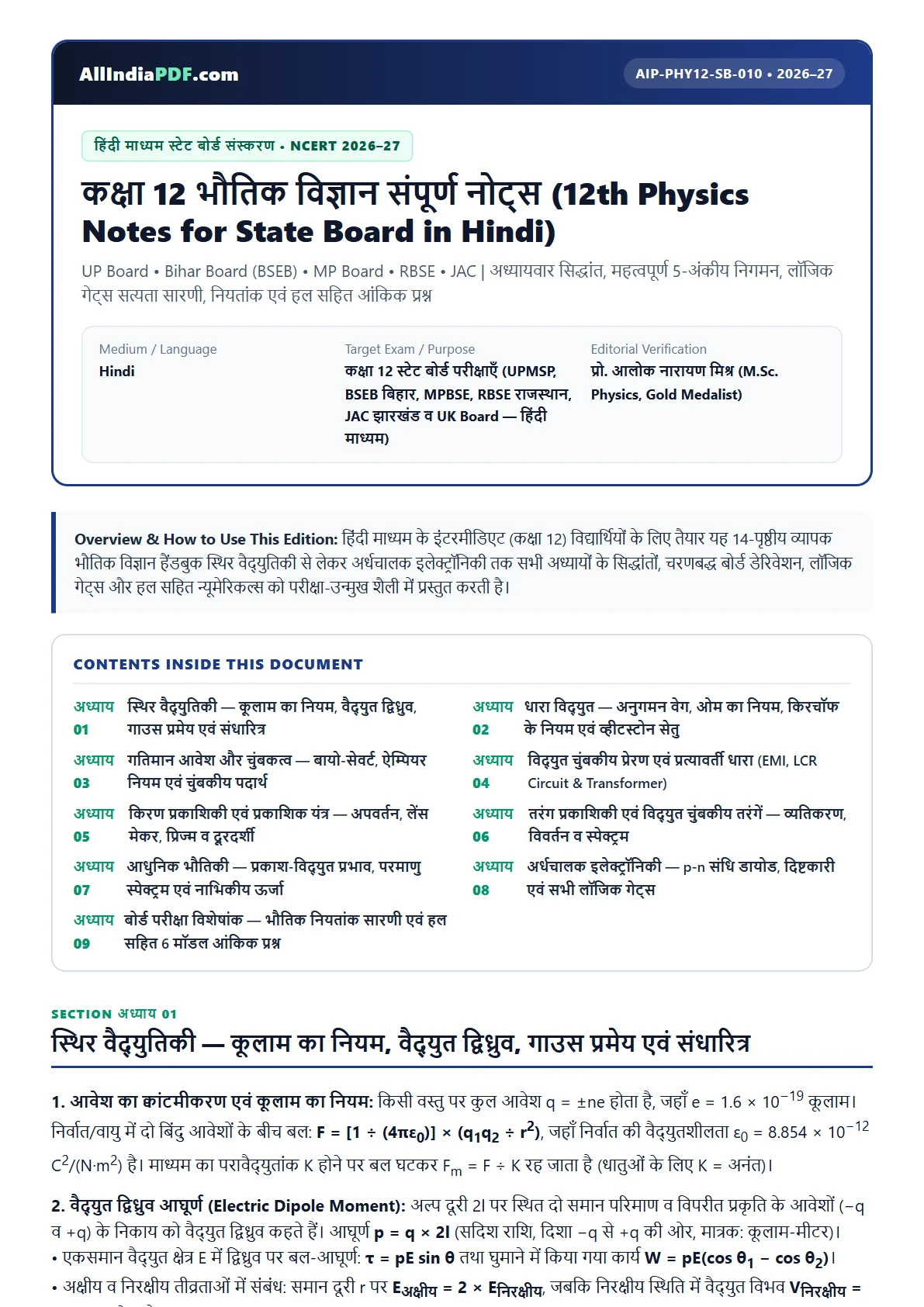
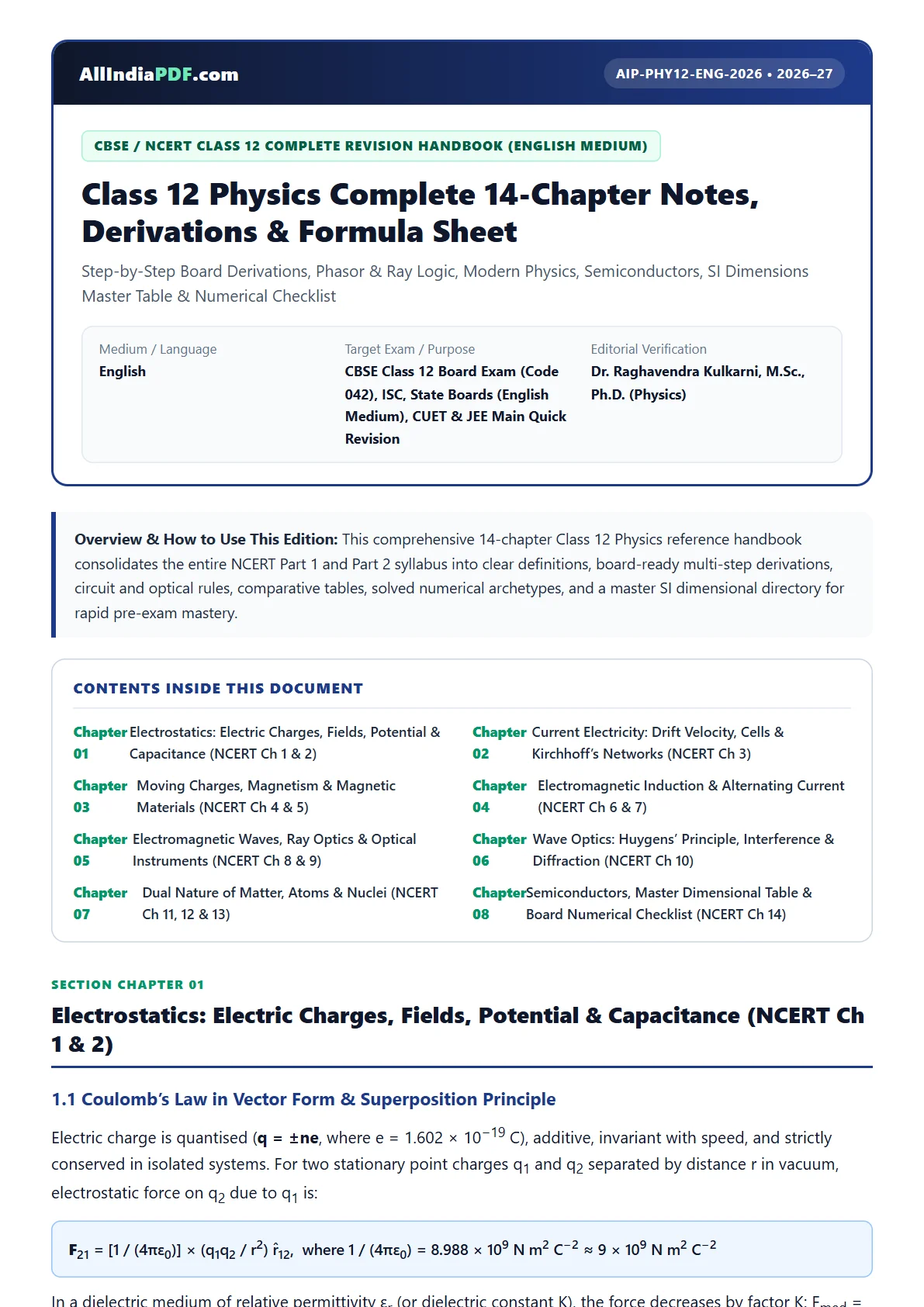
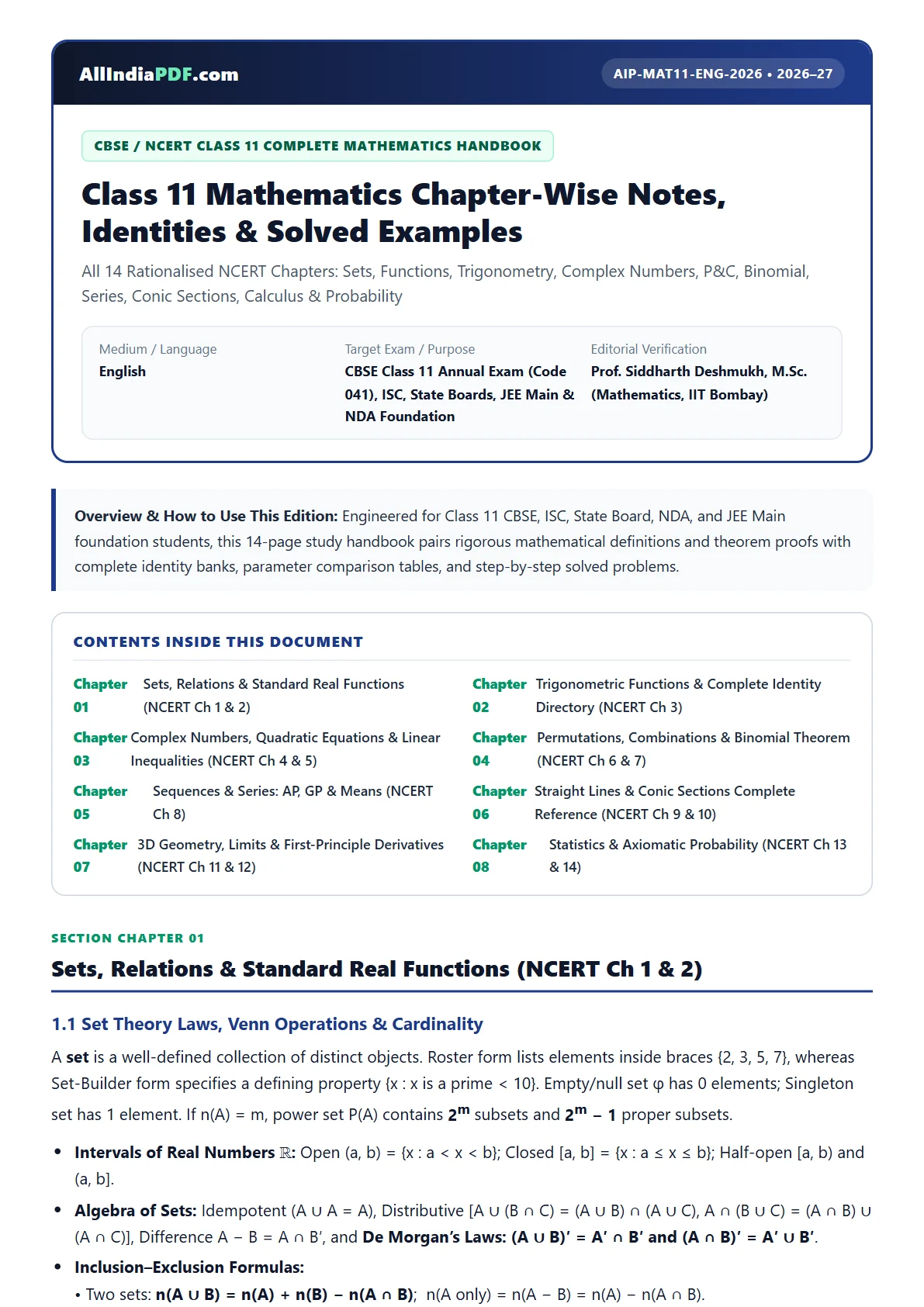
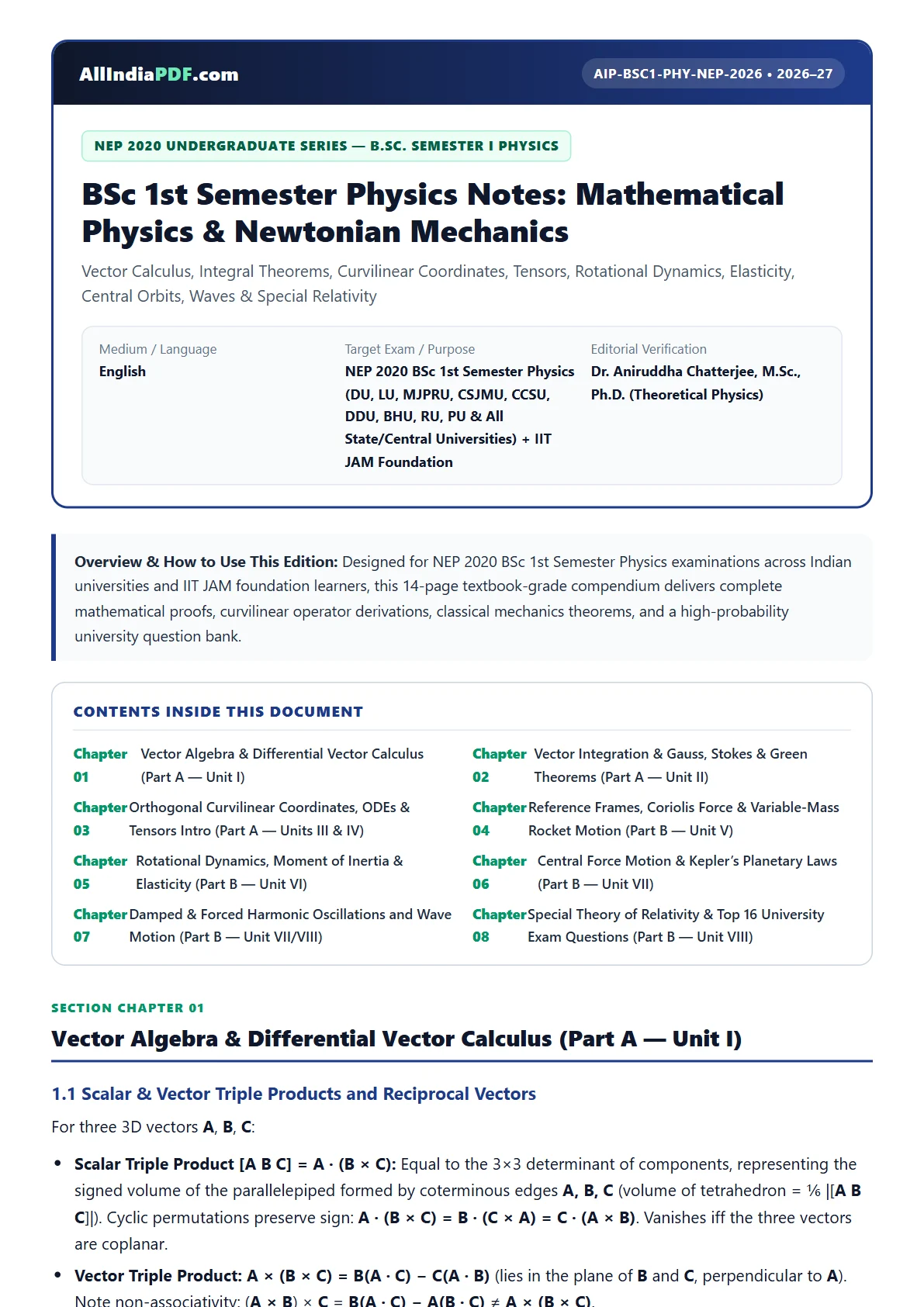
Inside Document Preview (Pages 1–3 of 9)
Actual print-ready pages from the verified 2026–27 PDF compilation.
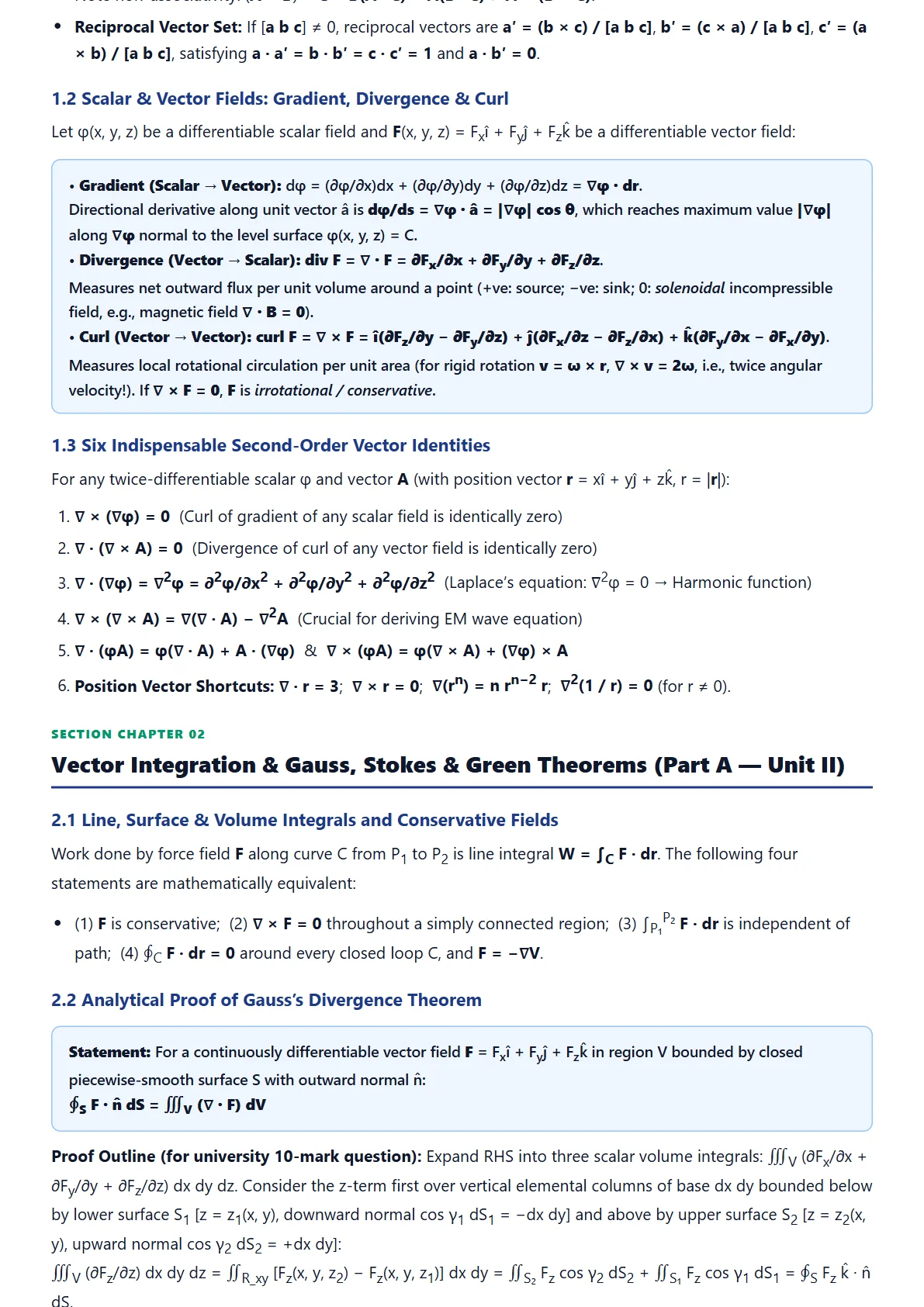
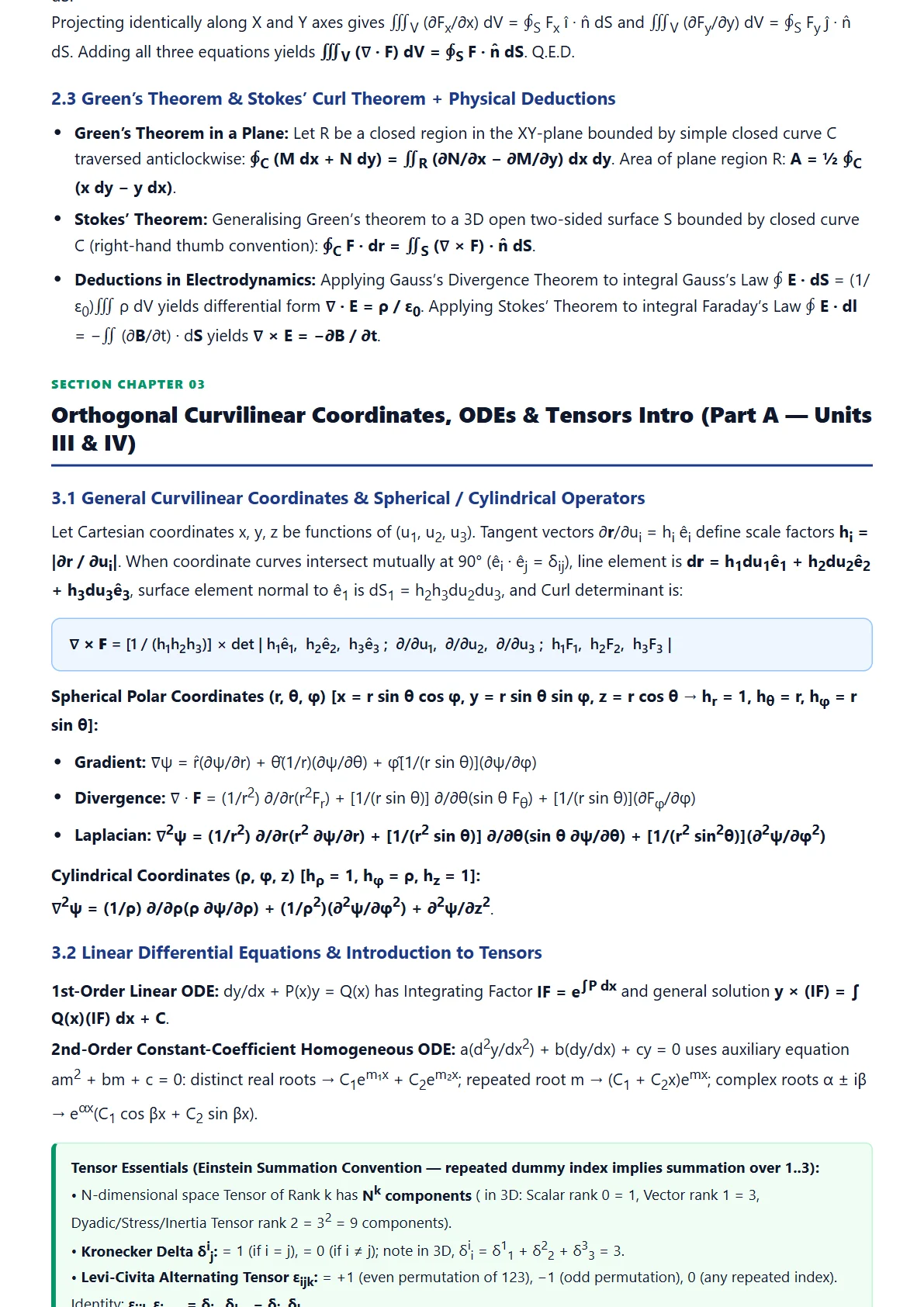
Continue Reading All 9 Full Pages Offline
Verify your email address to access the complete 9-page printable PDF with all chapters, tables, and solved examples.
In This Study Guide
- 1.1. NEP 2020 BSc 1st Semester Physics Syllabus & High-Weightage Topics
- 2.2. Vector Algebra, Differential Operator Del (∇) & Integral Theorems
- 3.3. Orthogonal Curvilinear Coordinates Master Table (Cartesian, Cylindrical & Spherical)
- 4.4. Newtonian Mechanics, Elasticity, Central Orbits & Relativity Formulas
- 5.Complete PDF Chapter Breakdown
- 6.Frequently Asked Questions
Key Highlights
- Aligned with the NEP 2020 Common Minimum Syllabus (Part A: Basic Mathematical Physics & Part B: Newtonian Mechanics & Wave Motion)
- Complete proofs of Vector Triple Product, Gradient, Divergence, Curl, Gauss Divergence Theorem, Stokes’ Theorem & Green’s Theorem
- Side-by-side Orthogonal Curvilinear Coordinates Master Table for Cartesian, Cylindrical (ρ, φ, z), and Spherical Polar (r, θ, φ) systems
- Full derivations of Coriolis Force, Variable-Mass Rocket Equation, Parallel/Perpendicular Axes, Cantilever Bending, and Kepler’s Laws
- Includes Damped/Forced Harmonic Oscillations, Phase vs Group Velocity, and Special Theory of Relativity (Lorentz Transformations)
Under the National Education Policy (NEP 2020) Common Minimum Syllabus adopted across major Indian state and central universities, the BSc 1st Semester Physics core theory paper unites two foundational pillars into a single semester course: Part A — Basic Mathematical Physics and Part B — Newtonian Mechanics & Wave Motion. Students entering university directly from Class 12 often struggle because university examiners expect rigorous 3D vector-operator proofs, general curvilinear coordinate derivations, and differential-equation treatments rather than school-level plug-and-play formulas.
These BSc 1st Sem Physics Notes provide a structured, university-exam-focused reference written in clear academic English. Directly on this page, you can revise the complete 8-unit NEP syllabus map, vector differential and integral identities, the orthogonal curvilinear scale-factor table, and essential mechanics and relativity equations before accessing the 14-page print-ready A4 study handbook.
1. NEP 2020 BSc 1st Semester Physics Syllabus & High-Weightage Topics
Most Indian universities divide the BSc Semester-I theory paper (75 Marks External + 25 Marks Internal CIE) into eight structured units spanning Mathematical Physics and Classical Mechanics:
| Paper Section & Units | Core Syllabus Topics | Repeated Long-Answer University Derivations |
|---|---|---|
| Part A (Units I–II): Vector Algebra & Vector Calculus | Triple products, Del operator (∇), Gradient, Divergence, Curl, Line/Surface/Volume integrals, Gauss, Stokes & Green theorems. | BAC–CAB vector triple product proof, physical meaning of Divergence & Curl, proof & verification of Gauss Divergence and Stokes’ Theorems. |
| Part A (Units III–IV): Coordinate Systems & Tensors Intro | Orthogonal curvilinear coordinates, Cartesian, Cylindrical & Spherical polar systems, Differential equations, Kronecker delta, Tensors. | Expressions for ∇φ, ∇·F, ∇×F and ∇2φ in general curvilinear and spherical polar coordinates; Symmetric & antisymmetric tensors. |
| Part B (Units V–VI): Dynamics of Particles, Rigid Bodies & Elasticity | Non-inertial frames, Coriolis force, Centre of Mass, Variable-mass rocket, Moment of Inertia, Elastic constants (Y, K, η, σ), Cantilever. | Coriolis force on rotating Earth, Tsiolkovsky rocket equation, Parallel/Perpendicular axes theorems, relation Y = 3K(1 − 2σ) = 2η(1 + σ), Cantilever depression. |
| Part B (Units VII–VIII): Central Forces, Waves & Relativity Overview | Central force orbit equation, Kepler’s planetary laws, Satellites, Damped & forced harmonic motion, Phase/Group velocity, Lorentz transformations. | Differential equation of central orbit d2u/dθ2 + u = f(1/u)/(L2u2/m), Kepler’s 3rd Law, Resonance & Q-factor, Length contraction & Time dilation. |
2. Vector Algebra, Differential Operator Del (∇) & Integral Theorems
Part A opens with vector products and spatial rates of change governed by the vector differential operator ∇ = î(∂/∂x) + ĵ(∂/∂y) + k̂(∂/∂z):
• Scalar Triple Product (Volume of Parallelepiped): [A B C] = A · (B × C) (= 0 iff coplanar)
• Vector Triple Product (BAC–CAB Rule): A × (B × C) = B(A · C) − C(A · B)
• Gradient of Scalar Field φ: ∇φ = î(∂φ/∂x) + ĵ(∂φ/∂y) + k̂(∂φ/∂z) (normal to level surface φ = c; unit normal n̂ = ∇φ / |∇φ|)
• Divergence of Vector Field F: ∇ · F = ∂Fx/∂x + ∂Fy/∂y + ∂Fz/∂z (if ∇ · F = 0 everywhere, F is Solenoidal)
• Curl of Vector Field F: ∇ × F (if ∇ × F = 0 everywhere, F is Irrotational / Conservative, so F = −∇V)
The three Fundamental Integral Theorems bridge line, surface, and volume integrals across physics and electromagnetism:
- Gauss’s Divergence Theorem (Surface ↔ Volume): ∮S F · dS = ∭V (∇ · F) dV — outward flux of vector field F across closed surface S equals the volume integral of its divergence over enclosed volume V.
- Stokes’ Curl Theorem (Closed Curve ↔ Open Surface): ∮C F · dr = ∬S (∇ × F) · dS — circulation of F around closed boundary curve C equals the surface flux of curl F over any open surface S bounded by C.
- Green’s Theorem in the XY-Plane: ∮C (P dx + Q dy) = ∬R [(∂Q/∂x) − (∂P/∂y)] dx dy.
3. Orthogonal Curvilinear Coordinates Master Table (Cartesian, Cylindrical & Spherical)
For general orthogonal curvilinear coordinates (u1, u2, u3) with arc-length squared ds2 = h12du12 + h22du22 + h32du32, knowing the three scale factors (h1, h2, h3) instantly unlocks every vector operator:
| Coordinate System | Coordinates (u1, u2, u3) | Scale Factors (h1, h2, h3) | Volume Element dV = h1h2h3 du1du2du3 |
|---|---|---|---|
| Cartesian | (x, y, z) | h1 = 1, h2 = 1, h3 = 1 | dx dy dz |
| Cylindrical Polar | (ρ, φ, z) [x = ρ cos φ, y = ρ sin φ] | h1 = 1, h2 = ρ, h3 = 1 | ρ dρ dφ dz |
| Spherical Polar | (r, θ, φ) [z = r cos θ, x = r sin θ cos φ] | h1 = 1, h2 = r, h3 = r sin θ | r2 sin θ dr dθ dφ |
• Gradient: ∇φ = (ê1 / h1)(∂φ/∂u1) + (ê2 / h2)(∂φ/∂u2) + (ê3 / h3)(∂φ/∂u3)
• Divergence: ∇ · F = [1 / (h1h2h3)] [∂/∂u1(F1h2h3) + ∂/∂u2(F2h3h1) + ∂/∂u3(F3h1h2)]
• Laplacian: ∇2φ = [1 / (h1h2h3)] [∂/∂u1((h2h3/h1) ∂φ/∂u1) + ∂/∂u2((h3h1/h2) ∂φ/∂u2) + ∂/∂u3((h1h2/h3) ∂φ/∂u3)]
4. Newtonian Mechanics, Elasticity, Central Orbits & Relativity Formulas
Part B connects classical dynamics of particles, rigid bodies, elastic beams, planetary orbits, and relativistic frames:
- Rotating Frame & Variable-Mass Rocket: Apparent acceleration in frame rotating at ω includes Centrifugal force −mω × (ω × r) and Coriolis force Fcor = −2m(ω × v′). For a rocket ejecting exhaust at relative speed u against gravity g: v = v0 + u ln(M0 / M) − gt.
- Rotational Inertia & Elastic Constants: Perpendicular axes (planar lamina): Iz = Ix + Iy; Parallel axes (any 3D body): I = ICM + Md2. Isotropic elastic constants (Young’s Y, Bulk K, Rigidity η, Poisson’s ratio σ) satisfy: Y = 3K(1 − 2σ) = 2η(1 + σ) and 9 / Y = (3 / η) + (1 / K) (theoretical limits: −1 < σ < 0.5). Depression at free end of a light cantilever of length l loaded with weight W: δ = Wl3 / (3 Y Ig).
- Central Force Motion & Kepler’s Laws: Under central force F = f(r)r̂, torque τ = r × F = 0, so angular momentum L is conserved and areal velocity dA / dt = L / (2m) = constant (Kepler’s 2nd Law). Using u = 1/r, Binet’s orbit equation is d2u/dθ2 + u = −[m / (L2u2)] f(1/u), yielding conic section l / r = 1 + e cos θ and T2 = (4π2 / GM) a3.
- Wave Velocities & Special Relativity: Phase velocity vp = ω / k; Group velocity vg = dω / dk = vp − λ(dvp / dλ). With Lorentz factor γ = 1 / √(1 − v2/c2): Lorentz transformation x′ = γ(x − vt), t′ = γ(t − vx/c2); Length contraction L = L0 / γ; Time dilation Δt = γ Δt0; Relativistic energy–momentum relation E2 = p2c2 + m02c4.
What’s Included Inside the Complete 9-Page PDF
Structured specifically for fast revision, exam hall recall, and clean A4 printing:
Part A — Vector Algebra, Differential & Integral Calculus
Scalar and vector triple products, directional derivative, solenoidal and irrotational fields, second-order identities, and the three fundamental integral theorems.
Curvilinear Coordinates, Differential Equations & Tensors
Scale factors (h₁, h₂, h₃), line/volume elements, Laplacian in spherical and cylindrical coordinates, Kronecker delta, Levi-Civita symbol, and rank-2 tensors.
Part B — Particle Systems, Rotational Dynamics & Elasticity
Rotating frames, Coriolis acceleration, Tsiolkovsky rocket propulsion, moment of inertia theorems, flywheel, elastic constants (Y, K, η, σ), and cantilever depression.
Central Force Orbits, Oscillations, Waves & Special Relativity
Differential equation of central orbit, Kepler’s planetary laws, damped and driven LCR-mechanical oscillators, Q-factor, group velocity, and relativistic kinematics.
Ready to download the full 9-page printable PDF?
Instant access + backup copy delivered straight to your verified email address.
Frequently Asked Questions
Are these BSc 1st Sem Physics notes valid for my state or central university under NEP 2020?+
Yes. Under the UGC NEP 2020 Common Minimum Syllabus framework, Semester 1 Physics across UP State Universities (LU, MJPRU, CSJMU, CCSU, MGKVP, DDU, VBSPU, RMLAU), Delhi University, Rajasthan, MP, Bihar, Uttarakhand, and other universities covers Mathematical Physics & Newtonian Mechanics, all of which are thoroughly addressed in this 8-chapter handbook.
Do the notes include full proofs of Gauss’s Divergence Theorem and Stokes’ Theorem?+
Yes. Chapter 2 presents step-by-step analytical proofs of both Gauss’s Divergence Theorem and Stokes’ Curl Theorem using rectangular volume/surface elements, followed by solved university verification problems.
Are Spherical and Cylindrical coordinates derived from general curvilinear coordinates?+
Yes. Chapter 3 derives general expressions for Gradient, Divergence, Curl, and Laplacian in (u₁, u₂, u₃) and then substitutes exact scale factors for Cartesian (1, 1, 1), Cylindrical (1, ρ, 1), and Spherical Polar (1, r, r sin θ) coordinates.
Does Part B cover Elasticity (Cantilever & Torsion) as well as Central Force Orbits?+
Yes. Chapter 5 covers Moment of Inertia theorems, elastic constants inter-relations, twisting couple of a cylinder/wire, and bending of a cantilever beam, while Chapter 6 covers central force conservation laws, Binet’s differential orbit equation, and Kepler’s three planetary laws.
Are these notes also useful for IIT JAM Physics and CUET-PG revision?+
Absolutely. Mathematical Methods, Mechanics & General Properties of Matter, Oscillations/Waves, and Special Relativity together account for nearly 40% of the IIT JAM Physics and CUET-PG Physics syllabi, making these structured derivations and formula tables an ideal foundation.
Editorial Accuracy & Syllabus Verification (2026–27)
This guide was compiled by Dr. Aniruddha Chatterjee, M.Sc., Ph.D. (Theoretical Physics) (Associate Professor of Undergraduate Physics (14+ Years University Teaching)) and reviewed by Prof. Devendra Nath Tripathi, M.Sc., CSIR-NET JRF (University Board of Studies Reviewer — NEP Undergraduate Physics) in accordance with our Editorial Policy. Found a syllabus update or typo? Write to support@allindiapdf.com.